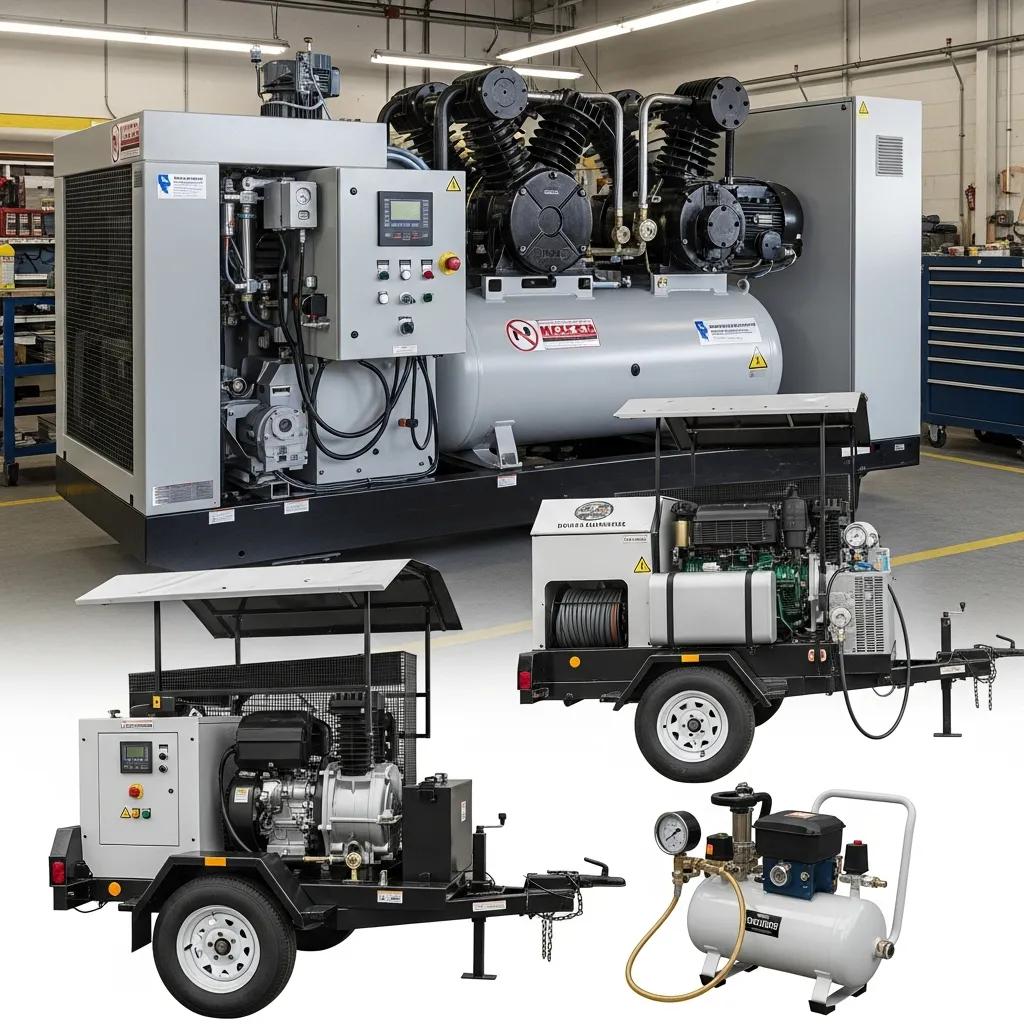
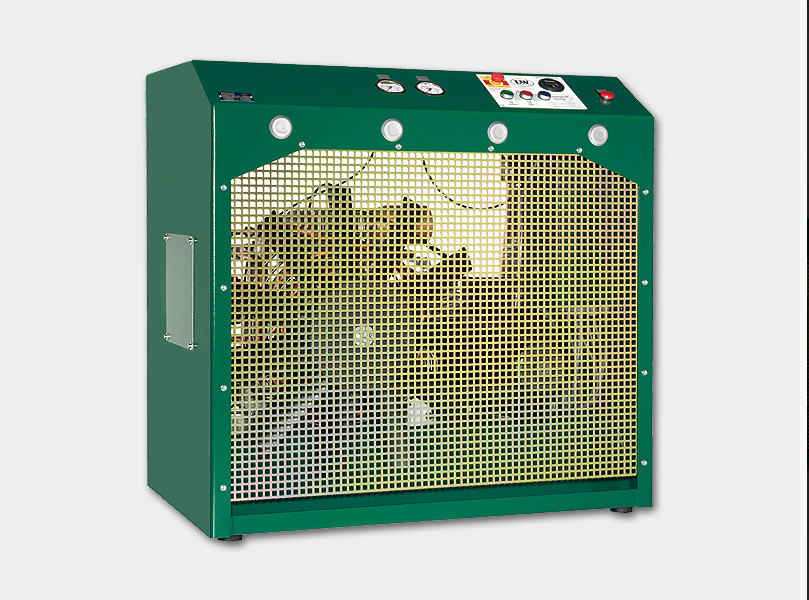
Understanding how compressor RPM (revolutions per minute) affects maintenance frequency, component wear, and equipment lifespan is crucial for optimizing performance and reducing operational costs. Compressor RPM is a key factor that influences the efficiency and longevity of compressor systems. By managing RPM effectively, operators can minimize wear on components, extend equipment lifespan, and reduce the frequency of maintenance interventions. This article will explore the definition of compressor RPM, its impact on component wear and failure modes, recommended maintenance intervals, and techniques for optimizing RPM to enhance equipment longevity.
What Is Compressor RPM and How Is It Measured?
Compressor RPM refers to the number of revolutions a compressor’s motor makes in one minute. It is a critical parameter that determines the operational speed of the compressor, influencing its performance and efficiency. RPM is typically measured using a tachometer, which provides real-time feedback on the motor’s speed. Understanding RPM is essential for operators, as it directly correlates with the compressor’s output and energy consumption. By monitoring RPM, operators can ensure that the compressor operates within optimal parameters, thereby enhancing its efficiency and reducing the risk of premature failure.
How Does Compressor RPM Affect Component Wear and Failure Modes?
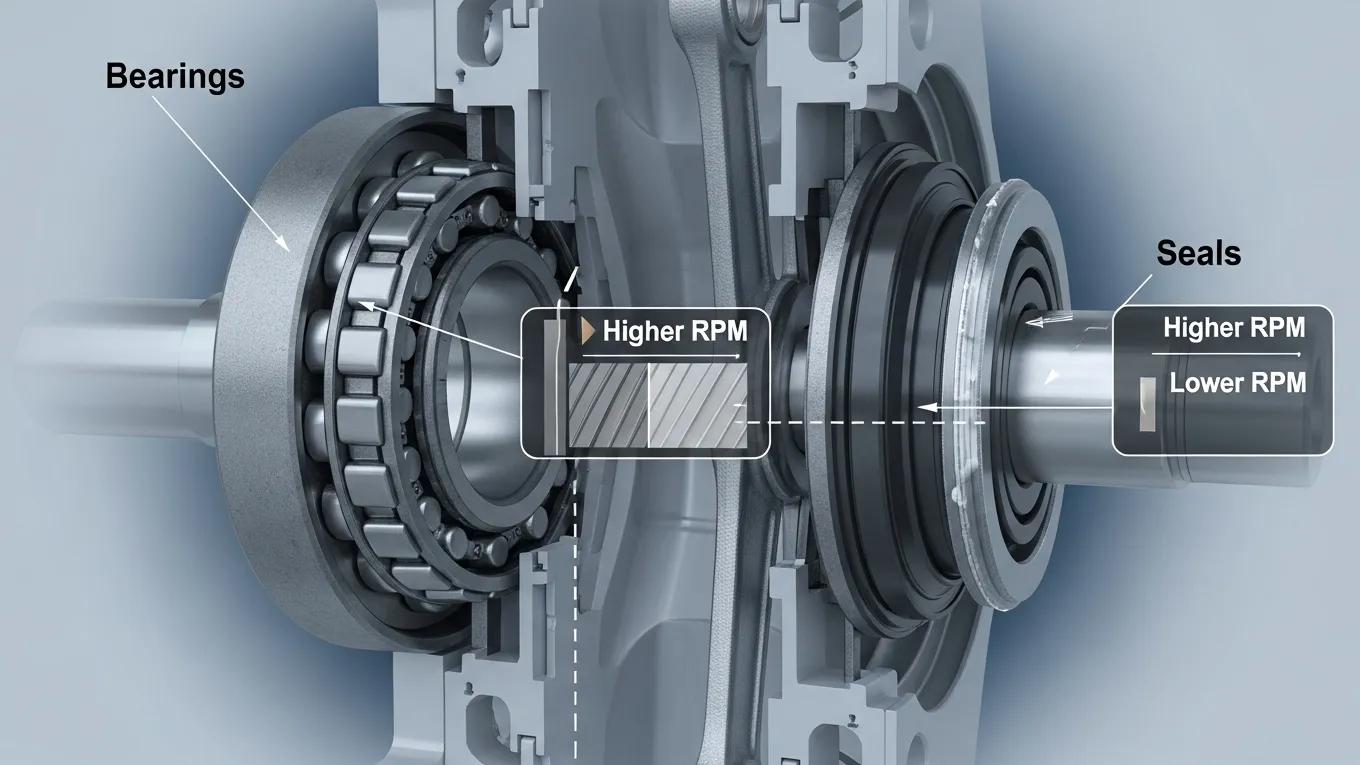
The RPM of a compressor significantly impacts component wear and potential failure modes. Higher RPMs can lead to increased friction and heat generation, which accelerates wear on critical components such as bearings and seals. This heightened wear can result in vibration issues, which further exacerbate the risk of failure. Conversely, operating at lower RPMs may reduce wear but can also lead to inefficiencies and inadequate performance. Therefore, finding the right balance in RPM is essential for maintaining the integrity of compressor systems and ensuring reliable operation.
Research further supports that managing compressor speed is critical for mitigating friction and wear, thereby enhancing efficiency and operational longevity.
Industry research also supports the relationship between compressor speed, friction, and component wear:
Compressor RPM: Impact on Friction, Wear, and Efficiency
Different outlet pressures and revolution speeds on test compressor indicated power increase with rising discharge pressure and revolution speed. The reduction compressor speed from 1500 RPM to 1000 RPM would decrease the effects of friction to almost twice. It’s important to use coatings like TiN or WC/C, which have good and very good, wear resistance properties in order to reduce friction and wear on rotary vane friction pair.
Vane friction and wear influence on rotary vane compressor efficiency and operation: research and analysis review, 2017
When comparing real-world systems—such as LW Americas and BAUER Compressors—RPM design differences can significantly impact maintenance requirements, component wear, and long-term system performance. For a detailed comparison, see our LW Americas vs Bauer compressors comparison.
Maintenance intervals vary based on compressor design, operating conditions, and manufacturer recommendations. The following examples illustrate how maintenance frequency may differ based on RPM, but actual service intervals should always follow manufacturer guidelines.
High RPM Compressors: Maintenance every 1,000 hours of operation or every three months, whichever comes first.
Medium RPM Compressors: Maintenance every 2,000 hours or every six months.
Low RPM Compressors: Maintenance every 3,000 hours or annually.
Environmental factors, such as operating conditions and load variations, should also be considered when determining maintenance schedules.
RPM Category
Maintenance Interval
Recommended Practices
High RPM
Every 1,000 hours
Frequent inspections and lubrication
Medium RPM
Every 2,000 hours
Regular checks on seals and bearings
Low RPM
Every 3,000 hours
Annual comprehensive maintenance
This table illustrates how maintenance intervals vary based on compressor RPM, emphasizing the need for tailored maintenance strategies. Note: These intervals are illustrative examples only and may vary significantly depending on compressor type, usage, and manufacturer specifications.
How Can Optimizing Compressor RPM Extend Equipment Lifespan?
Optimizing compressor RPM can significantly extend the lifespan of equipment by reducing maintenance frequency and minimizing component wear. By operating at the optimal RPM, operators can achieve a balance between performance and longevity. This optimization leads to several benefits:
Reduced Maintenance Frequency: Lower wear rates result in less frequent maintenance, saving time and costs.
Minimized Component Wear: Operating within the ideal RPM range decreases the stress on components, prolonging their life.
Enhanced Efficiency: Optimized RPM improves energy efficiency, leading to lower operational costs.
Techniques for RPM Control to Reduce Wear and Failure
Controlling RPM effectively is essential for reducing wear and preventing failures in compressor systems. Techniques for RPM control include:
Variable Frequency Drives (VFDs): These devices allow for precise control of motor speed, enabling operators to adjust RPM based on demand.
Regular Monitoring: Implementing monitoring systems can help track RPM and identify deviations from optimal levels.
Scheduled Maintenance: Regular maintenance ensures that components are in good condition, reducing the likelihood of failures related to RPM fluctuations.
By employing these techniques, operators can maintain optimal RPM levels, thereby enhancing the reliability and lifespan of their compressor systems.
Case Studies Demonstrating Lifespan Improvements Through RPM Management
Several case studies highlight the benefits of effective RPM management in extending equipment lifespan. For instance, a manufacturing facility that implemented VFDs on its high RPM compressors reported a reduction in maintenance costs and an increase in equipment lifespan. Another case study in the HVAC industry demonstrated that optimizing RPM led to a decrease in component failures, significantly improving operational efficiency.
These examples illustrate the tangible benefits of managing compressor RPM effectively, reinforcing the importance of this parameter in maintenance strategies and equipment longevity.
Understanding Compressor Specifications: Flow Rate, Pressure, and Duty Cycle Explained for Optimal Selection and Use
Compressors are specified by three primary attributes—flow rate, pressure, and duty cycle—and understanding how these interact is essential for choosing reliable equipment that meets safety and throughput needs. This article explains what each specification means, how to calculate required flow (CFM), how to interpret pressure ratings (PSI/BAR), and why duty cycle determines whether an intermittent or continuous-duty high-pressure compressor is suitable for a given application. Readers will learn step-by-step methods for sizing systems for breathing air, fills, and industrial tools, plus checklists to guide selection under real-world constraints such as altitude and peak demand. Practical examples and calculation templates are provided to help engineers, safety officers, dive operators, and facility managers translate requirements into a specification. Along the way we map common industry units and include reference tables for typical tools and compressor types to simplify decision-making. Finally, the article highlights trends—energy efficiency, continuous-duty platforms, and smart monitoring—that are shaping modern compressor specifications and procurement decisions.
What is Compressor Duty Cycle and Why Does It Matter?
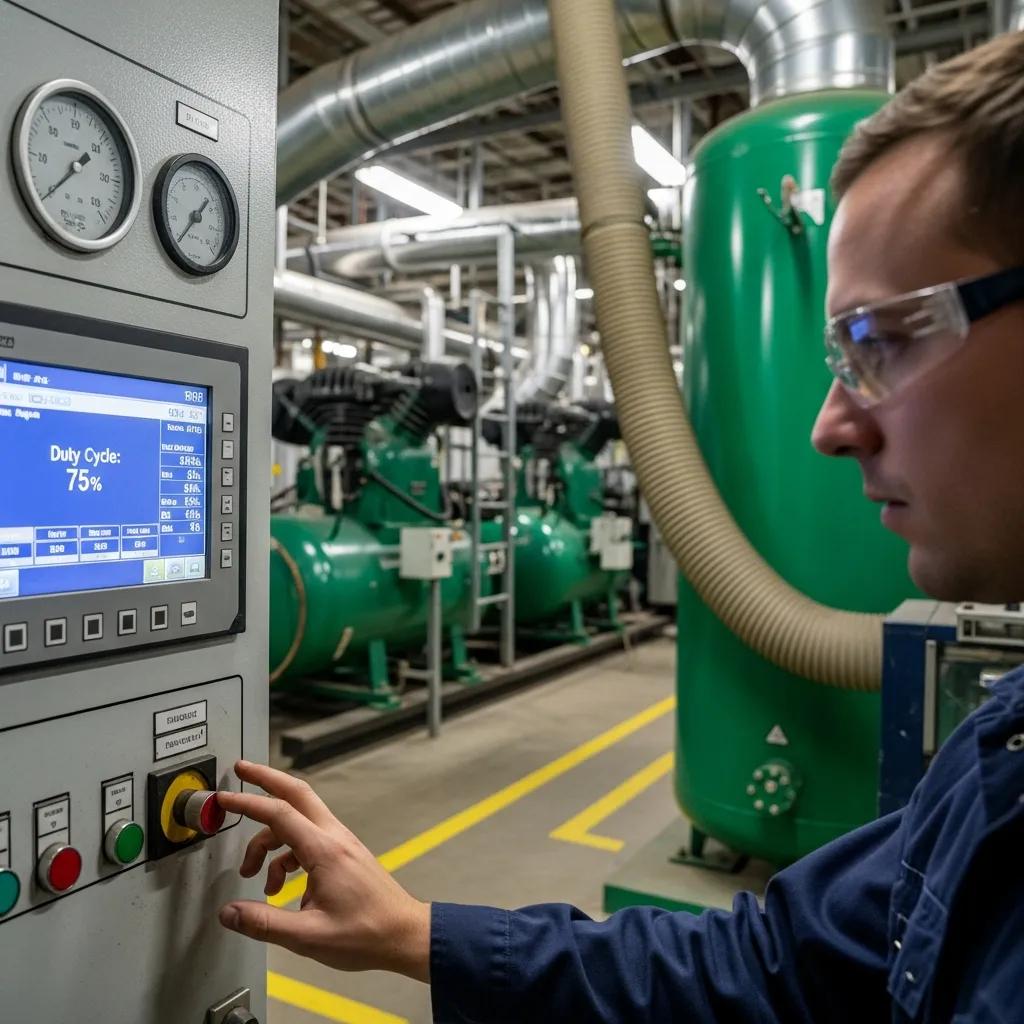
Compressor duty cycle is the percentage of time a compressor can operate within a defined period without overheating or exceeding design limits, and it directly governs usable run-time and recovery needs. The mechanism behind duty cycle is thermal balance: running components generate heat and specify cooling/rest periods to avoid damage, which means duty cycle affects wear, uptime, and safe load profiles. For applications requiring constant availability—breathing air fill stations, continuous production lines, or maritime standby systems—selecting a compressor with an appropriate duty cycle prevents premature failure and ensures consistent pressure and flow. Understanding duty cycle helps you match compressor architecture to operational profile and maintenance planning, which reduces unplanned downtime and safety risks. The next subsections define the math for duty cycle and distinguish between continuous versus intermittent designs to clarify selection criteria.
How is Duty Cycle Defined and Calculated?
Duty cycle is defined as runtime divided by total cycle time, expressed as a percent, and it quantifies allowable run time over a repeating period. The simple formula is: Duty Cycle (%) = (Run Time / Cycle Time) × 100, which engineers use to size cooling, motor duty, and required rest intervals; for example, 30 minutes run in a 60-minute cycle equals a 50% duty cycle. When calculating for applications, include peak-load bursts and average run to determine thermal accumulation; a compressor rated 50% duty in a 60-minute window cannot be run continuously without risk of overheating. Practical considerations include ambient temperature, inlet air conditions, and compressor cooling design, all of which alter effective duty cycle in the field. This calculation leads directly into design choices: whether a continuous-duty platform is required or an intermittent unit will suffice.
What Are the Characteristics of Continuous and Intermittent Duty Cycles?
Continuous-duty compressors are engineered to run at or near 100% duty with robust cooling, heavier-duty components, and design features that reduce thermal stress, whereas intermittent-duty compressors are intended for shorter run windows with mandatory rest periods. Continuous designs typically use enhanced heat dissipation, one-piece cast blocks, and serviceable components to sustain long fills or production processes, which are characteristics that support longevity and reliability for critical breathing air or industrial operations. Intermittent units are lighter-weight, less costly, and appropriate where duty cycles are low and predictable, but they demand scheduling and potentially redundant units for peak coverage. Maintenance impacts differ: continuous platforms require condition monitoring and scheduled service for high-temporal uptime, while intermittent systems focus on periodic inspection after accumulated run hours. Understanding these distinctions frames the next topic: how flow rate (CFM) relates to the selected duty cycle during peak and average demand.
How to Understand and Calculate Flow Rate for Your Compressor Needs
Flow rate measures the volume of gas delivered per unit time—commonly cubic feet per minute (CFM)—and it determines how many fills or tools a compressor can support concurrently. Mechanically, flow relates to displacement, stages, and free air delivery (FAD); rated CFM often differs from FAD because conditions, intake losses, and elevation reduce usable output. Calculating required CFM starts with listing concurrent demands, converting each demand to CFM-equivalent, summing peak flows, and adding a safety margin (commonly 10–25%) to cover surges and inefficiencies. **For safety-critical systems, this initial calculation should always be followed by a professional engineering review.** Accurately sizing CFM informs both pump selection and duty-cycle expectations because higher continuous flow increases thermal load and may necessitate continuous-duty equipment. The subsections below define CFM and provide step-by-step calculations for typical high-pressure applications, including worked examples for breathing-air fills.
What Does Cubic Feet per Minute Mean in Compressor Performance?
CFM (cubic feet per minute) indicates the volumetric flow delivered by a compressor under specified inlet and discharge conditions, and it is a primary metric for throughput and tool compatibility. Free air delivery (FAD) is the standardized measure of CFM at intake conditions; rated CFM may be higher but not reflect actual usable output after losses, so always compare FAD figures when sizing systems. In practice, CFM determines how fast you can fill cylinders or run multiple pneumatic devices simultaneously; for example, a higher CFM rating supports more rapid SCBA or scuba tank fills and can reduce queue time in busy operations. Environmental factors such as altitude and temperature lower FAD, while filter or dryer pressure drops reduce delivered flow, so specification sheets must be interpreted in context. These interpretation details feed into the calculation steps for specific tools and fill stations described next.
How to Calculate CFM Requirements for High-Pressure Air Tools and Applications?
Calculating CFM begins by converting each demand into cubic feet per minute at operating pressure, summing concurrent needs, and applying a contingency margin to account for peaks and inefficiencies. Step-by-step: identify each device or fill cycle, determine per-item CFM or fill time converted to CFM, sum all concurrent flows, add a safety margin (10–25%), and then select a compressor whose FAD meets or exceeds that adjusted total. Example: a fill station that completes four scuba fills per hour (each equivalent to 0.5 CFM averaged over fill duration) plus continuous tool use requiring 3 CFM yields a baseline of 5 CFM; adding a 20% margin results in a 6 CFM requirement. While these steps provide a robust framework for initial sizing, **for safety-critical applications like breathing air, a comprehensive engineering review is essential to ensure compliance with all relevant standards and safety protocols.** Consider duty cycle and recovery time: if peak demands occur regularly, upsizing flow or selecting continuous-duty equipment is required to avoid performance degradation. The table below lists common tools and approximate CFM requirements to help translate application needs into specification numbers.
Different tools and fills demand distinct flow rates. The values below are **illustrative averages** and can vary significantly based on compressor size, fill method, storage banks, and specific equipment. Always consult manufacturer specifications and conduct a thorough engineering review for precise requirements.
Application
Illustrative Average CFM Demand (Varies Widely)
Typical Use Case
SCUBA cylinder fill (per station average)
0.5–1.5 CFM during fill
Recreational dive shop fills
SCBA fill (per station average)
1–3 CFM during fill
Fire department refill station
Continuous pneumatic tool (per tool)
2–8 CFM
Production line grinders or nailers
Peak burst (multiple tools)
Variable, sum of tool CFM
Workshop peak shifts
Note: The CFM values provided in this table are illustrative averages for common use cases and are not normative specifications. Actual CFM requirements will vary significantly based on specific compressor models, fill methods, storage bank configurations, and operational parameters. Always refer to equipment manufacturer data and conduct a detailed engineering assessment for accurate sizing.
This table helps translate operational profiles into a target FAD requirement, and the next section shows how pressure interacts with these flow needs when selecting equipment.
What Does Compressor Pressure Indicate and How to Interpret It?
Pressure specifications (commonly PSI and BAR) indicate the force per unit area that the compressor can deliver and sustain, and they determine whether the system can reach the necessary fill or operating pressure for an application. Mechanically, maximum pressure defines safety limits such as relief valve settings and material design, while working or service pressure is the normal operating point where components must be rated. Interpreting pressure means distinguishing between gauge reading, absolute pressure, and rated maximum; conversions (PSI to BAR) and safety margins are essential for matching regulator and cylinder requirements. Industry applications often require high-pressure compressors rated for specific maxima—for example, breathing air cylinders often require fill pressures in the 3000–4500 PSI range—so identifying working pressure is the first step before checking flow and duty cycle. The following subsections describe measurement methods and present rating ranges mapped to industry use-cases.
How is Pressure Measured and What Are Safe Operating PSI Ranges?
Pressure is measured using calibrated gauges and sensors that report gauge (relative) or absolute values; instrumentation accuracy and calibration intervals are critical for safety in breathing air and medical applications. Typical safe operating ranges vary by application: general pneumatic systems often operate below 200 PSI, industrial high-pressure tools can require 300–1000 PSI, and breathing air cylinders for scuba or SCBA commonly require fill pressures of 3000–4500 PSI depending on cylinder and regulator standards. Gauges should be installed with accessible calibration ports and pressure relief devices must be specified to trip below structural failure thresholds, providing an operational safety margin. Regular sensor checks and maintenance ensure that working pressure remains within rated limits and that control logic prevents over-pressurization. Mapping these pressures to industry applications is useful for selecting the correct compressor rating and safety architecture.
To make unit interpretation straightforward, the table below summarizes common pressure units and recommended ranges.
Unit / Metric
Typical Conversion
Typical Application Range
PSI (pounds/sq. in.)
1 bar ≈ 14.5 PSI
0–4500 PSI (typical target cylinder pressure for high-pressure fills)
BAR
1 bar ≈ 14.5 PSI
1–310 bar equivalents for industry
Recommended safety margin
Working pressure + 10–25%
Use for relief valve and component rating
What Are High-Pressure Compressor Ratings and Their Industry Applications?
High-pressure compressor ratings combine maximum PSI, rated CFM/FAD, and duty cycle to define suitability for industry tasks such as diving fills, firefighting SCBA, medical gas, and motorsports. Ratings must be interpreted together: a compressor rated for high PSI but low CFM may be fine for occasional high-pressure fills but unsuitable for continuous multi-station operations. Mapping rating ranges to applications helps identify when off-the-shelf models suffice versus when custom engineering is required; for example, continuous multi-station breathing-air systems generally require both high PSI capability and continuous-duty design. When specifying a system, include operational profile, expected simultaneous fills, required turnaround time, and air quality filtration to ensure the rating aligns with real use. The next section describes how specific applications drive those specification choices in practice.
Which High-Pressure Compressor Applications Require Specific Specifications?
Applications such as scuba fills, firefighting SCBA, medical gas supply, maritime systems, and motorsports place distinct demands on flow, pressure, air quality, and duty cycle, and these drivers determine compressor selection. Safety-critical uses—breathing air for diving and firefighting—prioritize air purity standards, continuous availability during operation, and specific pressure ratings, while industrial processes may emphasize throughput, redundancy, and cost per delivered cubic foot. Maritime and motorsports applications often require compact packaging, vibration resistance, and specialized mounting, which influence mechanical choices such as one-piece cast blocks and robust motor/drive assemblies. Understanding application-specific drivers lets you translate operational needs into concrete specifications like FAD at working pressure, required duty cycle, filtration stages, and control/monitoring capabilities. After reviewing these drivers, the product examples below illustrate how real-world compressor platforms can match those requirements.
LW Americas offers continuous-duty high-pressure compressor platforms and gas solutions designed for applications where uptime and air quality are critical. Their product range includes tankfill compressors and dedicated breathing-air systems such as NitroxMakers and YachtPro systems, and they provide custom engineering and project management to tailor systems to site demands. Key value propositions include a continuous-duty platform optimized for scuba tank fills, a one-piece cast block design for mechanical durability, and responsive North American support that assists with specification matching and installation. These offerings align with the demands described above: they target continuous operation, high-pressure fills, and custom configurations for maritime and industrial installations. The next subsections break down breathing air and industrial/medical specification drivers in more detail.
What Are Breathing Air Compressor Specifications for Diving and Firefighting?
Breathing air systems require controlled pressure, certified filtration, and adherence to recognized standards for air quality, with requirements that specify total hydrocarbons, CO, moisture, and particulate limits. Common station sizing uses high-pressure capability to meet target cylinder pressures (often 3000–4500 PSI) combined with rated FAD sufficient to meet turn-around times for multiple cylinders or SCBA packs; for busy operations, continuous-duty designs reduce queue and ensure safety margins. Filtration and drying stages are tailored to remove contaminants to levels that comply with applicable breathing air guidelines, and compressor controls must support monitoring of quality parameters and routine sampling. When planning a breathing-air station, define expected fills per hour, simultaneous fill points, required recovery times, and air quality test intervals to select an appropriate model. **Given the safety-critical nature of breathing air, a thorough engineering review and adherence to all applicable standards are paramount.** This specificity naturally leads to how industrial and medical contexts adjust those parameters differently.
How Do Industrial and Medical Applications Influence Compressor Selection?
Industrial and medical environments add constraints such as gas composition control, strict purity and sterility requirements, redundancy for critical systems, and environmental influences like ambient temperature and altitude. Medical-grade air demands filtration and controls that demonstrate consistent purity, while industrial plants prioritize peak versus average demand balancing and integration with plant controls and safety interlocks. Redundancy strategies—standby compressors, automatic switchover, or parallel arrays—are common where failure would halt production or endanger patients. These operational realities inform the sizing, duty cycle specification, and control architecture, and often trigger the need for custom engineering to produce 2D/3D installation drawings, integrated monitoring, and lifecycle maintenance planning.
How to Choose the Right Compressor: Sizing and Specification Guide
Choosing the correct compressor follows a stepwise framework: define demand (pressure, simultaneous flow, quality), calculate required FAD at working pressure including margins, select a duty cycle and architecture that supports peak and continuous loads, and verify installation environmental factors. This decision checklist simplifies procurement and helps ensure the chosen compressor meets performance and safety needs without overspending on unnecessary capacity. **However, for safety-critical applications, these steps serve as a preliminary guide and must be complemented by a comprehensive engineering review.** Consider altitude, inlet temperature, gas type, and planned redundancy, as these factors directly change FAD and cooling requirements; selecting a model that lists FAD at site conditions reduces risk of underspecification. Use the EAV reference table below to compare continuous-duty piston designs with rotary options for common trade-offs in duty cycle, max PSI, and typical applications.
Use this checklist when shortlisting compressor options:
Define required working pressure and air quality standards for the application.
Calculate peak and average CFM needs including safety margin and simultaneous use.
Match duty cycle rating to operational profile and determine redundancy needs.
Compressor Type
Typical Duty Cycle
Typical Max PSI / Rated CFM
Typical Applications
Continuous-duty piston
~90–100%
High output pressure capability (e.g., to fill cylinders to 3000–4500 PSI) / Moderate CFM
Breathing-air fills, dive shops
Intermittent piston
20–60%
Moderate PSI / Lower continuous CFM
Workshop fills, occasional use
Rotary high-flow
70–100%
Lower max PSI / High CFM
Industrial continuous flow applications
What Factors Affect Industrial Compressor Sizing and Performance?
Environmental factors like altitude and ambient temperature reduce effective FAD because thinner or hotter intake air contains less mass per volume, which decreases volumetric efficiency and output. Operational profiles—whether a plant has frequent peaks or steady continuous demand—determine whether to prioritize peak CFM or average throughput and whether to include automatic sequencing or parallel units. Technical factors include inlet filtration, cooler capacity, motor drive sizing, and the compressor’s mechanical design (for example, a one-piece cast block improves durability and reduces leak potential). Mitigations include oversizing for altitude, using variable-speed drives for soft-loaded cycles, and planning extra filtration or pre-cooling to preserve FAD. Understanding these factors supports the duty-cycle and flow interaction analysis outlined next.
How Do Duty Cycle, Flow Rate, and Pressure Interact in Compressor Selection?
Duty cycle, flow rate, and pressure interact as a triad where increasing one parameter often forces trade-offs in the others: higher pressure at the same displacement reduces available flow and elevates thermal load, which lowers sustainable duty cycle. Scenario example: a single-stage compressor delivering high PSI for scuba fills will have lower continuous CFM than a multi-stage unit designed for higher flow at moderate pressure; selecting between them depends on whether the operation prioritizes rapid single fills or continuous multi-station throughput. Prioritization guidance: for breathing-air safety and continuous fills, prioritize duty cycle and pressure first, then flow; for industrial production, prioritize flow and duty cycle, then pressure. **It is crucial to remember that for safety-critical systems, these guidelines are foundational, and a detailed engineering review is indispensable.** When requirements cross typical product boundaries, custom engineering and project management—including 2D/3D drawings and tailored configurations—are recommended to achieve the optimal balance.
LW Americas provides sizing and project management services that illustrate this process in practice, using custom engineering, drawings, and continuous-duty platforms to match site-specific duty cycles and flow requirements. Their approach includes translating operational demand into specification documents and producing installation-ready 2D/3D layouts to ensure fit and serviceability, while leveraging their continuous-duty platform and one-piece cast block designs for durability. This professional sizing support is useful when off-the-shelf options do not align cleanly with complex duty-cycle, pressure, and flow interactions described here. The next section explores how technology trends are changing these decisions.
What Are the Latest Trends and Innovations in Compressor Specifications?
Recent trends shift compressor specifications toward energy efficiency, continuous-duty-ready architectures, and smarter monitoring that informs lifecycle and maintenance decisions. Engineering improvements—variable-speed drives, enhanced head and cylinder designs, and optimized cooling—reduce operating cost per delivered cubic foot while enabling longer continuous operation without thermal compromise. Concurrently, IoT and predictive maintenance tools provide telemetry such as vibration, temperature, and delivered FAD that allow operators to move from reactive to predictive service models. These innovations change procurement logic: buyers increasingly value total cost of ownership, uptime guarantees, and integration-ready monitoring when specifying pressure, flow, and duty cycle. The following subsections examine efficiency/continuous-duty developments and monitoring impacts in more detail and close with how suppliers are positioning continuous platforms in the market.
How Are Energy Efficiency and Continuous-Duty Platforms Changing Compressor Design?
Energy efficiency improvements—like variable-speed drives and optimized compression staging—reduce power consumption while preserving or increasing delivered FAD, which can lower operating cost and enable continuous duty with less thermal stress. Continuous-duty platforms incorporate robust mechanical components and cooling strategies such as improved head design and one-piece cast blocks to sustain long run times with predictable maintenance intervals. These design advances mean that applications once requiring complex parallel arrays can now achieve uptime with fewer, more efficient units, shifting specification emphasis to lifecycle cost and serviceability. Operationally, energy-efficient continuous platforms often require upfront investment but deliver lower total cost per delivered cubic foot and higher resilience for critical breathing-air systems. This engineering progress naturally complements smarter monitoring; the next subsection covers how telemetry improves specification and maintenance decisions.
What Role Does IoT and Smart Monitoring Play in Modern Compressors?
IoT-enabled monitoring collects KPIs—FAD, motor load, vibration, coolant temperature, and oil condition—and transmits them for predictive maintenance and performance optimization, which improves uptime and informs specification choices. By analyzing telemetry trends, operators can detect declining FAD, increasing motor current, or abnormal vibration before failure occurs, allowing duty cycles to be adjusted or service scheduled proactively. Monitoring also supports specification validation at installation: measured FAD and pressure under real site conditions confirm whether the compressor matches the design assumptions used during selection. For organizations designing critical breathing-air or continuous industrial systems, telemetry-ready compressors reduce risk and provide data for long-term asset planning. Suppliers that combine continuous-duty platforms with monitoring readiness offer a compelling package for modern procurement and operations.
LW Americas’ continuous-duty platform and emphasis on project management position it as a vendor option for organizations seeking integrated continuous-operation systems with support for custom engineering and installation drawings. For buyers whose specifications require sustained high-pressure fills and robust uptime, LW Americas’ combination of continuous-duty designs, one-piece cast blocks for durability, and North American support provides a pathway from specification to commissioned system. If you require a tailored solution that combines appropriate pressure, flow, and duty cycle with monitoring and project-managed installation, contacting a specialist provider can accelerate specification validation and deployment.
For a custom quote or technical consultation, request details from the equipment provider and share your operational profile.
Provide expected simultaneous fills, turnaround requirements, ambient conditions, and air quality standards so the vendor can size appropriately.
Ask for 2D/3D installation drawings, continuous-duty platform references, and support commitments to ensure the solution meets operational and maintenance expectations.
These steps close the loop between specification theory and practical procurement, helping ensure the chosen compressor aligns with real-world demands.
Industrial High-Pressure Air Compressor Systems: Applications and Solutions for Manufacturing and Energy Sectors
Please note: The content presented here is intended to provide conceptual frameworks and design principles related to high-pressure compressor systems. It is not intended as licensed engineering guidance, design specifications, or a substitute for professional engineering advice. Specific applications require detailed engineering analysis and adherence to all applicable codes and standards.
Industrial high-pressure air compressor systems compress and deliver gas at pressures significantly above standard plant pneumatic levels to power specialized machinery, perform pressure testing, and handle fuel compression tasks. These systems operate through multi-stage compression, intercooling, and precision valving to maintain stable delivery pressure and meet purity or safety requirements, which yields predictable process outcomes and reduced downtime. Understanding how continuous-duty designs, oil-free options, and application-specific accessories interact provides a framework for optimizing compressed air systems in manufacturing, CNG fueling, and energy-sector gas handling. This article explores core compressor types, component roles, manufacturing applications, and energy-sector uses, presenting conceptual frameworks for selection criteria, maintenance considerations, and energy-efficiency technologies. This discussion outlines conceptual implementation patterns for manufacturing compressed air systems, explores how CNG and biogas compression supports renewable fuels and vehicle fueling, and identifies accessory types—such as purification modules, boost pumps, and air amplifiers—that are integral for system integrity and throughput. The discussion integrates vendor capabilities sparingly to illustrate real-world solutions, focusing on conceptual technical considerations for professionals involved with industrial high-pressure compressor systems.
What Are Industrial High-Pressure Air Compressors and Their Key Benefits?
Industrial high-pressure air compressors are mechanical systems designed to raise the pressure of air or gas to levels typically required for specialty applications, often ranging from tens up to several hundred bar depending on the task. They achieve this through staged compression, intercooling, and robust mechanical design, providing stable, high-pressure delivery that enables reliable actuation, pressure testing, and filling operations across sectors. The main benefits include sustained uptime from continuous-duty capability, precise pressure control for process consistency, and enhanced safety and purity when paired with proper filtration and monitoring. In manufacturing and energy contexts, these attributes can contribute to reduced process variability, shorter cycle times, and support for regulatory compliance, particularly for specialized applications like breathing air or fuel-grade gas. The next subsection explains how continuous-duty compressors offer operational advantages and which engineering features make them suitable for nonstop industrial use.
How Do Continuous-Duty High-Pressure Compressors Enhance Industrial Operations?
Continuous-duty high-pressure compressors are engineered to run without frequent cool-down periods by using lower RPM components, robust cast blocks, and thermal management strategies that dissipate heat effectively during prolonged operation. This design reduces thermal stress on key components, maintains steady pressure delivery, and minimizes the risk of unplanned stops—improving overall equipment availability for critical manufacturing lines and fueling stations. Continuous operation also means fewer start/stop cycles, which decreases wear on valves and seals and lengthens maintenance intervals compared with intermittent-duty machines. For operations prioritizing uptime, continuous-duty designs offer a conceptual framework for predictable scheduling and smoother integration with storage tanks and downstream purification stages. Understanding these benefits highlights why customization is often a key consideration for aligning continuous-duty compressors with specific site constraints and purity requirements.
What Makes Custom High-Pressure Compressor Solutions Essential for Manufacturing and Energy?
Off-the-shelf compressors may not meet unique requirements for footprint, purity, pressure staging, or integration with existing plant controls, so custom solutions adapt core compressor designs to site-specific constraints and performance targets. A project-managed custom solution often involves stages such as requirements capture, compressor selection, engineering design, packaging, and site support, aiming to ensure the final system aligns with the operational and regulatory environment. Tailored systems can improve lifecycle cost and regulatory compliance by optimizing component selection and service access, which reduces downtime and simplifies maintenance planning. The decision checklist below presents considerations for determining when a custom approach might be preferred over a standard packaged unit.
Conceptual considerations for custom compressor solutions:
Space-constrained installations: When footprint or mounting orientation is non-standard.
Strict purity or breathing-air needs: When integrated inline purification and monitoring are critical design elements.
Process integration requirements: When controls, piping, or storage need bespoke interfaces.
Such a checklist can assist in prioritizing customization, and the following section compares major compressor families to inform initial selection considerations.
Which High-Pressure Compressor Types Are Best Suited for Manufacturing and Energy Applications?
Choosing the right compressor type depends on required pressure range, duty cycle, contamination sensitivity, and lifecycle costs; common families include reciprocating (piston), rotary screw, and specialized high-pressure piston assemblies for extreme pressures. Each family delivers different trade-offs in efficiency, maintenance cadence, footprint, and suitability for oil-free operation, making a structured comparison useful for selection decisions. Below is a compact comparison that maps compressor type attributes to typical use cases and operational considerations, providing a conceptual framework for professionals.
Different compressor types offer characteristic trade-offs useful during system selection.
Compressor Type
Typical Duty / Oil-Free Option
Typical Pressure Range
Best Use Cases
Reciprocating (piston)
Continuous to intermittent / Oil-free available
Up to 420 bar (for specialized systems)
High-pressure filling, pressure testing, CNG fill stations
Rotary screw
Continuous-duty / Often oil-lubricated, oil-free variants exist
Variable, often reaching up to 420 bar for specific models
Mobile filling, vessel service, remote fueling
It’s important to note that while some specialized reciprocating and compact units can reach pressures up to 420 bar, this represents the upper end of the spectrum for specific high-pressure applications, not a typical range for all industrial compressors. This comparison clarifies that reciprocating designs excel where very high pressures or compact high-pressure packages are required, while rotary screw units suit continuous plant air at moderate pressures. The next subsections explain advantages and trade-offs across these families and the role of oil-free design for contamination-sensitive industries.
What Are the Advantages of Reciprocating and Rotary Screw Compressors?
Reciprocating compressors deliver high discharge pressures in compact packages and are well-suited for intermittent high-pressure fills and testing operations because each piston stage produces substantial pressure increase per stroke. They typically have higher peak efficiency at high pressures but may require more frequent valve and seal maintenance compared with rotary screw machines, which trade slightly lower peak efficiency for smoother operation and fewer vibration-related issues. Rotary screw compressors offer continuous-duty reliability with simpler vibration profiles and often integrate well with variable speed drives for energy savings on variable flow applications. Design principles often suggest reciprocating machines for extreme pressure or compact mobile systems, while rotary screws are typically considered for steady, high-volume plant compressed air where lower maintenance frequency and reduced vibration are priorities. These trade-offs point to oil-free considerations discussed next, particularly for breathing air and medical uses.
How Do Oil-Free and Continuous-Duty Compressors Improve Efficiency and Safety?
Oil-free compressors are designed to mitigate oil carryover risk into the compressed air stream, supporting compliance with purity standards, particularly those referenced in industry guidance for applications like breathing air and sensitive manufacturing processes. The mechanism is simple: oil-free designs use materials and clearances that avoid oil lubrication in the compression chamber or rely on separation stages that prevent contamination, protecting downstream processes and product quality. Continuous-duty capability complements oil-free design by maintaining stable temperatures and pressures that can reduce condensation and microbial growth risks in compressed-air networks. For regulated applications such as medical gas, food processing, and breathing air, the combination of oil-free compression with effective purification and monitoring is a critical design consideration for ensuring safety and compliance. Having considered compressor families and purity choices, the following section explores concrete manufacturing applications and system design patterns.
How Are High-Pressure Systems Applied in Manufacturing Compressed Air Solutions?
High-pressure air systems in manufacturing power specialized equipment, enable high-precision testing, and provide process air for material handling, cutting, and automated tooling; the design must balance pressure, flow, storage, and purity. Typical system architectures include a high-pressure compressor, intercooler and aftercooler stages, purification modules, storage receivers, and controlled distribution piping with safety valves and monitoring. Conceptual design for manufacturing often involves addressing transient loads—such as rapid pressure swings during press or test rig cycles—and may incorporate storage and boost pumps to buffer demand and sustain pressure during peaks. Below is a focused list of primary manufacturing applications and approximate pressure ranges, intended to assist in conceptually matching compressor selection to use-case requirements.
Primary manufacturing applications and their pressure profiles include the following.
Manufacturing uses of high-pressure air:
Pneumatic presses and actuators: Typically require 6–40 bar for high-force applications, and sometimes higher for specialized presses.
Pressure testing and leak detection: Often use 100 bar, with specialized applications reaching up to 420 bar depending on vessel rating and test standard.
Cleaning and material handling (blow-off, pneumatic conveyors): Use 6–10 bar for general tasks and higher pressures for dense material transport.
These applications illustrate the importance of integrated design—conceptually matching compressor capacity, storage, and downstream purification—and the next subsection highlights how custom packaged solutions can address these manufacturing challenges.
What Are the Primary Manufacturing Uses of High-Pressure Air Compressors?
Manufacturing environments rely on high-pressure air for actuation of heavy tooling, precision pressure testing of welded assemblies, and high-velocity cleaning or cutting processes that require consistent pressure and pulsation control. Pressure testing of fittings, cylinders, and safety devices may demand pressures approaching the compressor’s upper rating, a scenario that conceptually requires robust staging and safety systems to mitigate overpressure risks. Material handling and pneumatic conveyance benefit from booster stages or air amplifiers to increase flow at point-of-use without overtaxing the main compressor, enhancing throughput while limiting upstream cycling. These practical uses underscore the importance of appropriate sizing, storage, and accessory selection for maintaining efficiency and safety, leading into a short vendor-focused callout illustrating how tailored solutions can contribute.
How Do LW Americas’ Custom Solutions Address Manufacturing Challenges?
LW Americas offers continuous-duty high-pressure compressor systems and tailored project management, aiming to align compressor selection with manufacturing needs while emphasizing system durability through design choices such as one-piece cast blocks and lower RPM operation. Their approach encompasses coordination of compressor selection, and providing 2D/3D design drawings and packaging options that can simplify mechanical integration in various operational environments. By combining engineered packaging with responsive North American support and accessories—such as purification modules, filling devices, and boost pumps—these solutions are designed to reduce installation time and help ensure the delivered package addresses purity and footprint requirements. This vendor-level capability illustrates how a managed custom workflow can shorten specification cycles and reduce integration risk, transitioning naturally to energy-sector compression roles discussed next.
What Roles Do CNG Compressor Systems Play in Energy Sector High-Pressure Gas Applications?
CNG and biogas compressor systems enable conversion of low-pressure gas into high-pressure forms suitable for vehicle fueling, pipeline injection, and storage, supporting both conventional natural gas and renewable natural gas (RNG) value chains. These systems typically use multi-stage reciprocating compression with intermediate cooling and cleanup stages to handle variable gas quality and ensure the compressed fuel meets fueling or grid injection specifications. It is crucial to note that while the principles of compression are similar, systems handling natural gas or biogas require specific material selection, safety features, and design modifications compared to those used for air, due to the distinct chemical properties and potential hazards of these fuel gases. Key system design considerations include gas purification upstream of compression, materials compatibility for biogas constituents, and efficient thermal management for controlling discharge temperatures and lubricants. The next subsection describes how CNG and biogas compressors integrate into fueling infrastructure and renewable gas handling workflows.
How Do CNG and Biogas Compressors Support Renewable Energy and Vehicle Fueling?
Compressors specifically designed for CNG and biogas convert produced or farmed biogas and RNG into pressurized fuel for CNG vehicles or pipeline injection, often in staged compression steps to reach 200–250 bar for vehicle cylinders or pipeline pressure specifications. Unlike air compressors, these systems require specialized components and safety protocols to handle flammable and corrosive gas mixtures. Integration with gas cleanup and moisture removal is a critical design consideration to mitigate corrosion, hydrate formation, and particulate fouling that can compromise seals and valves; when treating biogas, material selection and filtration approaches often need to address siloxanes and other contaminants. Operational considerations include intermittent versus continuous fueling demand, storage sizing, and site-level heat recovery to improve overall plant efficiency. Properly designed CNG compressor systems conceptually link renewable gas sources to end-use markets, and the next vendor-focused subsection highlights product attributes that can support energy efficiency.
What Are the Benefits of LW Americas’ High-Pressure Compressors for Energy Efficiency?
LW Americas’ continuous-duty, lower-RPM compressor designs and one-piece cast block construction contribute to durability and reduce mechanical losses that can translate into energy and lifecycle advantages for CNG and biogas applications. When paired with integrated project management and responsive support, these design attributes aim to ensure the compressor is sized and staged appropriately, which can mitigate throttling and part-load inefficiencies often associated with poorly matched systems. The company’s product range—covering mobile, compact, stationary, and silent units, with specialized models reaching up to 420 bar—provides options for fueling stations, mobile fueling units, and pipeline boosting where energy performance and uptime are priorities. These vendor capabilities illustrate how CNG and biogas equipment selection and system-level design conceptually interact to impact efficiency, moving the discussion next to components and accessories that can optimize performance.
Which Components and Accessories Optimize High-Pressure Compressor System Performance?
A high-pressure compressor package is only as effective as its supporting components: purification systems, breathing air monitoring, filling devices, boost pumps, storage tanks, valves, and safety accessories all shape safety, purity, and throughput. Purification stages are designed to remove oil, particulates, moisture, and hydrocarbons to meet application-specific purity targets. Separately, breathing air monitors provide continuous verification for safety-critical air supplies, a distinct and highly regulated application. Boost pumps and filling devices manage flow and pressure at point-of-use, reducing main compressor cycling and improving fill rates, and air amplifiers can increase localized pressure for short-duration tasks without oversized main compressors. The table below clarifies component functions, typical benefits, and common specifications, offering a conceptual framework for system designers to consider which accessories to incorporate.
Key components and their roles in system performance.
Component
Primary Function
Typical Benefit / Spec
Purification system
Remove contaminants (oil, moisture, particulates)
Supports ISO-level air quality; protects downstream equipment
Breathing air monitor
Real-time air quality verification
Safety assurance for breathing air; alarm and interlock capability
Filling device / booster pump
Increase local pressure and flow
Faster fills; reduced main compressor cycling
Air amplifier
Localized pressure boost without large compressor
Cost-effective short-duration pressure increase
How Do Purification Systems and Breathing Air Monitoring Enhance Safety and Quality?
Purification systems typically combine coalescing filters, dryers, activated carbon, and adsorbents to remove oil vapor, moisture, and hydrocarbons to meet application-specific purity targets, and their selection depends on inlet air quality and required ISO 8573-1 classes. Breathing air monitoring complements purification by tracking oxygen levels, CO, hydrocarbons, and particulate concentrations, triggering alarms and interlocks when readings exceed safe thresholds. The conceptual placement of monitors is often considered critical—typically after final filtration but before distribution—to help ensure that any degradation in purification performance is detected prior to user exposure. For regulated breathing-air duties and sensitive manufacturing, combining multi-stage purification with continuous monitoring is a key design principle for supporting compliance and operator safety, which naturally brings attention to boost pumps and filling devices that can enhance operational flexibility.
What Are the Functions of Filling Devices, Boost Pumps, and Air Amplifiers?
Filling devices and boost pumps raise pressure locally to speed vessel fills or maintain pressure during peak demand, reducing the need to oversize the main compressor and smoothing transient loads on the plant system. Air amplifiers use the Venturi effect or staged boosting to increase localized pressure for short-duration tasks, offering a cost-effective alternative where continuous high pressure is unnecessary. Conceptual integration often involves check valves, pressure relief mechanisms, and monitoring to mitigate backflow or overpressure conditions. Maintenance frameworks typically recommend routine inspection of seal integrity and flow paths. The selection of these accessories, based on duty cycle and fill-rate requirements, can contribute to improved throughput and reduced wear on core compression equipment. The next section covers energy-efficiency measures and maintenance practices that extend equipment life.
How Can Energy Efficiency and Maintenance Practices Extend the Life of High-Pressure Compressors?
Proactive energy-efficiency measures and structured maintenance programs reduce operating costs and extend compressor life by minimizing stress, optimizing control, and catching wear patterns early through monitoring. Technologies like variable speed drives (VSDs), heat recovery systems, and IoT-enabled condition monitoring deliver quantifiable savings and predictive maintenance insights while introducing implementation considerations such as control complexity and payback timelines. Routine maintenance—filter changes, vibration analysis, oil and seal inspections, and scheduled overhauls—prevents performance degradation and avoids catastrophic failures that lead to long downtimes. The table below compares efficiency technologies by expected energy impact, maintenance benefits, and implementation considerations, offering a conceptual framework for decision-makers to balance ROI and operational readiness.
Efficiency technologies compared for decision-making.
Technology
Energy Impact
Maintenance / Implementation Consideration
Variable Speed Drive (VSD)
Potential for substantial savings in variable-load scenarios
Adds control complexity; requires soft-start and harmonics management
Heat recovery
Captures waste heat for plant use
Reduces net energy consumption; needs space and integration
IoT condition monitoring
Lowers unplanned downtime via alerts
Requires sensors and analytics; improves spare-part planning
What Are Best Practices for Maintaining Continuous-Duty High-Pressure Compressors?
A robust maintenance framework for continuous-duty compressors often encompasses monthly visual and operational checks, quarterly filter and oil-level verification (if applicable), and annual vibration and thermal analysis to identify early signs of wear. Predictive maintenance focuses on monitoring temperature, vibration spectra, and oil condition (when present) to schedule interventions before failures occur; maintaining a critical-spares list for valves and seals shortens repair times. Documentation of running hours and load patterns can inform overhaul timing and support the conceptual justification for investments in upgrades like VSDs or enhanced cooling. Implementing these practices can contribute to reduced unplanned downtime and extended component life, which supports broader energy-efficiency considerations discussed next.
How Do Energy-Efficient Technologies Reduce Operational Costs in Industrial Settings?
Energy-efficient technologies such as VSDs, heat recovery, and IoT monitoring deliver measurable operational savings by matching compression output to demand, reusing waste heat for plant processes, and enabling early fault detection to avoid inefficient operation. VSDs reduce energy consumption during partial-load operation by adjusting motor speed to demand, offering significant savings depending on duty profile, while heat recovery can offset process heating loads and shorten payback on larger installations. IoT monitoring reduces lifecycle costs by optimizing maintenance scheduling and reducing catastrophic failures, though it requires upfront sensor and analytics investment. Balancing these options against implementation complexity and expected ROI provides a conceptual framework for achieving sustained cost reductions and reliability. For teams seeking vendor support for design, drawings, and delivery, LW Americas offers project-managed compressor solutions, including custom 2D/3D drawings and support for system integration.
Operational savings: VSDs and heat recovery lower net energy costs through demand matching and reuse of thermal energy.
Maintenance savings: IoT monitoring reduces downtime and extends component life by enabling predictive repairs.
Implementation trade-offs: Upfront costs and control complexity must be weighed against lifecycle savings and reliability goals.
Explore Tailored High-Pressure Solutions
For specific quotes, custom designs, 2D/3D drawings, and project-managed compressor selection, connect with LW Americas for tailored high-pressure solutions and responsive North American support.
SCBA Fill Station Setup: Complete Guide for Fire Departments to Design, Operate, and Maintain Safe Breathing Air Systems
An SCBA fill station is the centralized system a fire department uses to compress, purify, store, and dispense breathing air for self-contained breathing apparatus (SCBA), supporting daily training and emergency responses. This guide explains how to design, size, and operate an SCBA fill station so crews maintain readiness, minimize downtime, and are designed to align with air-quality requirements, often referencing standards such as NFPA 1989, which is commonly adopted by many fire departments. Specific requirements can vary by Authority Having Jurisdiction (AHJ) and local regulations. Readers will learn needs assessment methods, equipment selection criteria, purification and monitoring approaches, storage and fill-panel layout considerations, plus operation, maintenance, and troubleshooting best practices. The article also highlights practical vendor-grade options and project support examples to show how manufacturers can simplify design and installation without dictating choices. Start here with an operational definition and proceed through design checklists, compressor comparisons, purification EAV tables, and a maintenance matrix that together form a complete blueprint for breathing air system setup and sustained alignment with standards.
What Is an SCBA Fill Station and Why Is It Critical for Fire Departments?
An SCBA fill station is a breathing air system designed to compress ambient air to high pressure, filter contaminants, store the compressed air, and supports safe filling of SCBA cylinders for firefighter use. It works by combining a high-pressure air compressor with multi-stage purification, high-pressure storage (cascade) tanks, and a distribution/fill panel to aim to provide cylinders with air that aligns with health and safety criteria. The primary benefit is reliable on-site access to breathing air that is designed to align with recognized standards, which can help reduce response delays and address operational risks associated with using off-site fills. Understanding this central role sets the stage for how design choices can influence safety, readiness, and alignment with commonly adopted regulatory guidelines, such as those found in NFPA 1989. It’s important to note that specific requirements vary by Authority Having Jurisdiction (AHJ) and local regulations.
How Does an SCBA Fill Station Support Firefighter Safety and Operations?
An on-site SCBA fill station supports rapid cylinder turnaround by enabling immediate refills after training or incident use, which can contribute to improved crew readiness and help reduce response gaps. The mechanism begins with continuous-duty compressors that deliver required flow to the purification train and cascade storage so multiple cylinders can be filled in sequence, limiting queuing during peak demand. Operationally, integrated air quality monitoring helps detect potential contaminated fills by flagging CO, CO2, or oil vapor excursions and triggering isolation or shutdown actions. Having these capabilities on site translates into measurable improvements in fill-rate performance and reduces logistical dependence on external suppliers, which benefits both daily operations and emergency surge scenarios.
What Are the Different Types of SCBA Fill Stations Used by Fire Departments?
Fire departments typically deploy several fill station configurations—stationary centralized systems for main stations, mobile trailer-mounted units for on-scene or regional mutual aid, cascade-only storage for high-volume buffering, and hybrid combinations that mix fixed compressors with mobile support. Stationary systems are optimized for consistent high-throughput filling at a fixed location, while mobile systems serve as crucial situational support tools, prioritizing transportability, ruggedness, and on-scene refilling capability for remote training, emergency deployment, or temporary field support. Cascade storage systems act as high-pressure reservoirs that enable simultaneous rapid fills without immediate compressor output matching every demand spike. Selecting among these types depends on mission profile, geographic coverage needs, and expected fill cycles, which leads directly into design and selection criteria.
How to Design an Effective SCBA Fill Station for Fire Department Needs?
Designing an effective SCBA fill station starts with a systematic needs assessment followed by equipment selection, layout planning, and validation testing to support performance and safety goals. First quantify duty cycle, peak simultaneous fills, and future growth to size compressor capacity and cascade storage; then plan ventilation, noise control, and safety interlocks for the installation area. Incorporate purification and monitoring specifications that are designed to align with air-quality criteria, often referencing standards like NFPA 1989, which is commonly adopted by many fire departments. Specific requirements can vary by Authority Having Jurisdiction (AHJ) and local regulations. Document the system design in drawings and bills of material for procurement and commissioning. Good design can help reduce installation risk and simplify maintenance, so a clear project plan with deliverables and acceptance testing is essential before purchasing equipment.
The core steps for SCBA fill station design are:
Assess demand and duty cycle to determine required compressor flow and cascade capacity.
Select compressor technology and purification train matching air-quality and redundancy needs.
Design storage, fill panel layout, ventilation, and safety interlocks for the installation footprint.
Specify monitoring, testing protocols, and record-keeping designed to align with recognized standards, such as NFPA 1989, and other applicable local regulations.
Plan commissioning tests and ongoing maintenance schedules to validate performance.
These steps form a practical roadmap for design decisions and then guide specific component selection for compressors, purification, and storage.
What Are the Key Components in SCBA Fill Station Design?
Key components include the high-pressure compressor (multi-stage or reciprocating), a purification train (coalescing filters, molecular sieves, catalytic CO removal where required), high-pressure cascade storage tanks, a calibrated fill panel or manifold with gauges and pressure relief devices, and continuous air quality monitors for CO/CO2 and oil vapor. The compressor is the workhorse that determines flow-rate and pressure capabilities, while the purification train aims to support purity testing protocols for the compressed air to align with specified contaminant limits. Fill panels provide controlled distribution to cylinders and support safe filling procedures, and monitoring devices provide both real-time alarms and data logs for audits—each piece is interdependent in supporting the delivery of breathing air that is designed to align with standards.
Component
Function
Typical Specification
High-pressure compressor
Generates compressed air to required PSI and flow
Rated for pressures typically ranging from 4500–5000 psi service with continuous-duty capability
Purification train
Filters and captures particulates, oil, CO, VOCs
Multi-stage filters with molecular sieves and CO/CO2 monitoring
Cascade storage
Stores high-pressure air for rapid fills
Multiple high-pressure tanks for staged filling and redundancy
Fill panel / manifold
Distributes air to SCBA cylinders
Includes gauges, relief valves, and controlled outlets
Monitoring devices
Continuous air-quality alerts and logging
CO/CO2 sensors with alarm thresholds and data recording
This component matrix clarifies how each element contributes to system performance and informs procurement specifications for reliable operation.
How Do NFPA 1989 and Other Standards Influence SCBA Fill Station Design?
NFPA 1989 is a widely referenced standard that defines breathing air quality criteria, provides frameworks for testing intervals, and sets acceptable contaminant limits. It directly shapes purification train selection, monitoring thresholds, and validation testing for many SCBA fill stations. Complementary references like NFPA 1500 and CGA guidance also influence installation practices, operator training, and periodic hydrostatic testing of cylinders and tanks. While NFPA 1989 is commonly adopted by many fire departments, specific requirements can vary by Authority Having Jurisdiction (AHJ) and local regulations. These standards often require documented testing and records that demonstrate ongoing alignment with their guidelines, so design choices should prioritize test points, sample ports, and accessible monitoring for routine verification, with specific testing intervals typically ranging based on usage and jurisdiction. Incorporating acceptance tests into commissioning, aligned with adopted standards, supports the validation of the installed system against documented requirements and its readiness for operational use.
Which High-Pressure Air Compressors Are Best for Fire Department SCBA Fill Stations?
The best compressors for SCBA fill stations are continuous-duty, high-pressure units designed for sustained operation with robust cooling and service access, often optimized for lower operating speeds. Continuous-duty designs reduce thermal stress and allow longer run times during large filling campaigns, while architectures optimized for lower operating speeds reduce wear and vibration, which can contribute to extended service intervals. Stationary compressors are the primary solution, offering higher sustained flow and are ideally suited to centralized fill rooms for consistent, high-volume refilling. Mobile compressors, while portable, are best utilized as situational support tools for remote training, emergency deployment, or temporary field support, rather than as replacements for fixed installations. They often have constraints in power availability, cooling capacity, and maintenance access compared to their stationary counterparts. Choosing between types requires matching rated flow (CFM), discharge pressure (PSI), footprint constraints, and maintenance capacity to the department’s fill-rate and operational profile.
Compressor Type
Continuous Duty
Rated Pressure
Typical Flow (CFM)
Typical Use Case
Stationary compressor
Yes
4500–5000 psi
High (sustained)
Central station high-volume refilling
Mobile compressor
Some models
Pressures up to 5000 psi
Moderate
Situational support for on-scene refilling, remote training, or temporary field deployment
Tankfill (small-scale)
Varies
3000–4500 psi
Low–moderate
Small houses or training fills
What Are the Benefits of Continuous-Duty, Low RPM Compressors for Fire Departments?
Continuous-duty compressors, often designed for lower operating speeds, offer engineering advantages such as reduced mechanical stress, lower operating temperatures, and diminished vibration, which together can contribute to increased reliability and potentially extended service intervals. Practically, these benefits can contribute to fewer unscheduled outages, predictable maintenance windows, and potentially reduced lifecycle cost due to lower component wear. For fire departments that rely on uninterrupted access to breathing air, the smoother operation and potentially extended periods between service events support operational readiness and can help reduce the risk of compressor-related fill interruptions. These reliability improvements dovetail with purification and monitoring investments to support the delivery of consistent breathing air that is designed to align with standards.
How to Choose Between Mobile and Stationary SCBA Compressors?
Deciding between mobile and stationary compressors hinges on mission profile, expected fill volume, geographic coverage, and budget constraints. Stationary units are the foundational choice, excelling for centralized high-throughput needs and continuous operation. Mobile units, conversely, are optimal for incident support, remote refilling during training, or temporary field support where a fixed installation is not feasible or available. It is important to recognize that mobile units typically have limitations regarding sustained power availability, cooling capacity, and ease of maintenance access compared to dedicated stationary systems. Consider scenarios such as multi-station mutual aid, remote training events, or rural coverage to determine whether portability for situational support or consistent high-volume capacity is the priority. Evaluate footprint, electrical and ventilation requirements for stationary installs versus towing, mounting, and environmental protection for mobiles. The decision should align compressor capability with the department’s operational tempo and long-term plans, and include contingency planning for redundancy or temporary mobile augmentation without suggesting portable units replace the primary role of fixed installations.
How to Ensure Breathing Air Purification Meets Fire Department Standards?
Supporting breathing air purification to align with standards typically involves a multi-stage filtration approach, continuous and periodic monitoring, and a documented testing program tied to acceptance criteria from adopted standards. Purification typically involves multi-stage filtration that captures particles and oils, along with activated carbon or catalytic elements for hydrocarbons and VOCs, and molecular sieves for moisture control, combined with CO/CO2 sensors that can provide alarms before cylinder filling. Implement sampling points and test procedures into the system design so technicians can periodically verify contaminant levels under load. Establishing clear alarms, isolation protocols, and corrective actions in SOPs aims to ensure that any deviation from acceptable air quality is detected and addressed before providing air to firefighters.
What Filtration and Monitoring Systems Are Essential for SCBA Breathing Air?
Essential filtration and monitoring components include a staged filter train (pre-filter, coalescing oil remover, activated carbon or catalyst for hydrocarbons, and molecular sieve for moisture), plus continuous CO and CO2 monitors and oil vapor detectors. These elements work together to capture particulates, hydrocarbon vapors, and moisture that could potentially compromise cylinder air quality, while monitors provide immediate alerts and logging to support compliance. Proper sizing of filter elements and scheduled replacement intervals are critical, and alarms should be integrated into fill-panel controls so filling can be halted automatically when sensors exceed thresholds. This combination of filtration and monitoring is the backbone of breathing air systems designed to align with standards.
Purification Component
Removes
Monitoring / Threshold
Particulate / coalescing filter
Particles, liquid oil
Visual pressure differential; replace per hours
Activated carbon / catalyst
Hydrocarbons, VOCs
Periodic sampling; alarm on breakthrough
Molecular sieve / dryer
Moisture
Relative humidity indicators; dew point specs
CO / CO2 sensors
Combustion gases
Alarms at commonly referenced ppm thresholds (e.g., those found in NFPA 1989), supporting compliance with adopted standards.
These components must be matched to the compressor’s oil type and operating profile to support effective contaminant management through detection and filtration, and reliable monitoring.
How Does Compliance with NFPA 1989 Affect Breathing Air Purification?
NFPA 1989 is a widely referenced standard that sets measurable air-quality limits and provides frameworks for testing intervals. These often directly inform filter selection, monitoring alarm setpoints, and sample testing frequency for many fire departments. Systems are typically validated at commissioning and routinely re-tested to demonstrate ongoing alignment with adopted standards, with re-testing intervals typically ranging based on usage and jurisdiction. While NFPA 1989 is commonly adopted, specific requirements can vary by Authority Having Jurisdiction (AHJ) and local regulations. Adherence to adopted standards influences acceptance criteria such as acceptable ppm levels for CO and hydrocarbon presence, dew point limits, and documentation of corrective actions when limits are exceeded, with specific testing frequencies often outlined by the Authority Having Jurisdiction (AHJ) and manufacturer guidance. A compliance-driven approach requires integrating test ports, accessible sampling points, and a log system to record monitoring data, filter changes, and corrective maintenance, supporting auditors in tracing the system’s performance history and corrective measures if needed.
What Are Best Practices for SCBA Fill Station Operation, Maintenance, and Troubleshooting?
Best practices include establishing clear SOPs for operation and emergency shutdown, scheduling preventive maintenance aligned with duty cycles (with specific schedules typically ranging based on manufacturer guidance and local requirements), maintaining meticulous records for filters, oil changes, hours, and test results, and training personnel on first-line troubleshooting steps. A preventive maintenance matrix helps ensure critical tasks occur at appropriate intervals, which can vary based on duty cycle and manufacturer recommendations, and that parts such as filters and seals are replaced before failure. Troubleshooting protocols should start with basic diagnostics—power and controls checks, filter differential pressure, and sensor calibration—escalating to manufacturer support for specialized compressor block or purification failures. Implementing these practices reduces downtime and supports readiness for audits against adopted standards.
Everyday operational checklists and preventive maintenance routines keep a fill station reliable and aligned with standards while enabling rapid diagnosis when faults arise. While specific routines can vary, common frameworks include:
Daily checks: Visual inspection, oil level, drain moisture traps (these are common daily tasks).
Weekly checks: Monitoring differential pressure across filters and verifying alarms and gauges are common weekly tasks.
Monthly/quarterly: Replacing filters per manufacturer hours, calibrating sensors, and recording compressor hours are common monthly/quarterly tasks, though specific schedules should align with manufacturer guidance and local requirements.
These routine activities ensure system reliability and provide documentation for compliance audits, leading into a structured maintenance schedule and record-keeping approach.
How to Develop a Maintenance Schedule and Record-Keeping for SCBA Compressors?
Develop a maintenance schedule by mapping tasks to frequencies based on duty cycle and manufacturer guidance. This often includes daily checks, weekly operational verifications, and quarterly filter/service intervals, with annual major inspections including oil analysis and valve servicing. However, specific frequencies should always align with manufacturer recommendations and local requirements. Records should capture task, date, technician, compressor hours, filter part numbers, test results, and any corrective actions to create a history that supports audits. Digital logs with timestamped entries simplify trend analysis and support predictive maintenance, while paper backups can help meet basic record-retention requirements. Consistent record-keeping reduces risk and can demonstrate due diligence during inspections.
Task
Frequency
Record Type
Visual system inspection
Daily
Daily log entry
Oil level and leak check
Weekly
Service checklist
Filter element replacement
Per manufacturer hours / typically quarterly (actual frequency varies by usage and manufacturer guidance)
Parts log with serials
Sensor calibration and sample testing
Typically monthly/quarterly (actual frequency varies by usage and jurisdiction)
Test reports with ppm values, supporting compliance with adopted standards
Annual compressor overhaul
Typically yearly (actual frequency varies by usage and manufacturer guidance)
Service report and parts list
A structured matrix like this aligns maintenance actions with documented outcomes and supports compliant record retention.What Are Common Troubleshooting Steps for SCBA Fill Station Issues?
When facing common issues such as compressor failure to start, low fill rate, or contamination alarms, follow a tiered troubleshooting flow starting with operator-level checks, moving to technical diagnostics, and escalating to manufacturer support as needed. Begin by verifying power, control settings, and safety interlocks; if a low flow condition persists, check filter differential and suction conditions, and inspect for leaks in the cascade or fill panel. For contamination alarms, isolate the compressor, suspend fills, record sensor readings, and perform sample testing to confirm alarm validity before corrective remediation. Escalate to qualified service for compressor block, pump failures, or persistent contamination that simple filter changes do not resolve.
Basic diagnostics: Verify power and control status; reset alarms if needed.
Escalation: Contact qualified technical support for compressor block or purification train failures.
Following a clear escalation path can help preserve safety and minimize downtime while ensuring issues are addressed at the correct technical level.
Why Choose LW Americas for Custom SCBA Fill Station Solutions and Support?
LW Americas offers continuous-duty high-pressure compressors and gas systems designed to support life-safety applications, including offerings across tankfill compressors, stationary compressors, mobile compressors, filling panels, storage solutions, purification systems, and breathing air monitoring devices. Their product portfolio emphasizes continuous-duty operation, robust one-piece cast block construction, and designs optimized for lower operating speeds that reduce wear—attributes that can contribute to long-term reliability and potentially lower maintenance needs for fire department use. LW Americas also positions itself to provide responsive North American support and project management services that span equipment selection through design and installation oversight, making them a practical partner for departments seeking a turnkey design-to-support pathway that aims to align with commonly adopted standards, such as NFPA 1989, while acknowledging that specific requirements vary by Authority Having Jurisdiction (AHJ) and local regulations.
How Does LW Americas Provide Project Management and 2D/3D Design for Fire Departments?
LW Americas supports fire departments through a structured project workflow that begins with needs assessment and moves through equipment selection, 2D/3D system design, installation oversight, commissioning, and post-installation support. Deliverables typically include design drawings, bills of material, and commissioning reports that document performance against specified acceptance tests, which helps reduce installation risk and aims to ensure components are laid out for maintainability and alignment with adopted standards. Final compliance validation should always be coordinated with the Authority Having Jurisdiction (AHJ). Their project management approach aims to coordinate site requirements, ventilation, and safety interlocks with equipment delivery and commissioning to provide a coherent handover that includes operating and maintenance guidance for local staff.
What Are the Unique Value Propositions of LW Americas’ SCBA Fill Station Products?
Continuous-duty compressors: Support long run times and surge demands.
Designs optimized for lower operating speeds: Can contribute to reduced wear and maintenance frequency.
Project management & design: Can help minimize installation risk and supports documentation for compliance.
These product and service strengths can help a department translate technical requirements into a working, maintainable SCBA fill station configured to support their operational needs. Their local support presence in North America supports faster response for parts and technical queries, while custom solution capabilities and comprehensive project management reduce installation complexity. These attributes collectively support reliable fill-station uptime, predictable maintenance costs, and can facilitate compliance verification during audits against adopted standards, which are practical outcomes for departments managing life-safety infrastructure.
We deliver high-pressure compressors and the complementary modules for purification, storage and filling.
High performance complete solutions for reliable compression, purification, storage and recovery of inert gases such as helium and argon. This compressor series provides economic efficiency to the maximum due to loss-free compression by means of returning condensation and leak gases.
Take profit of our many years of experience in planning and construction of special systems for applications such as helium recovery, filling plants and different test plants as well as various other helium applications.
Applications
Type
From
To
Inlet pressure
atmospheric
150 bar (2100 psi)
Delivery capacity
6 m3/h (3,5 cfm)
700 m3/h (420 cfm)
Final pressure
10 bar (140 psi)
420 bar (6100 psi)
We individually calculate compressor and drive power according to your application requirement. In this way, we perform the best possible efficiency and highest economic feasibility for you.
Operating panel with start/stop and condensation test controls, final pressure gauge and hours counter
Automatic stop at final pressure
Automatic condensate drain
All pistons c/w steel piston rings at all stages
Hardened compression cylinders
Gas-tight intake filter
Oil lubrication
Oil- / Water separators after each stage
Inlet buffer tank 20 – 90 l (depending on version), incl. safety valve, manual condensate drain valve, pressure gauge and electrical cut-off solenoid for inlet gas
Filter system at the compressor
Safety valves after each stage
Final pressure safety valve with TÜV (German supervising authorities) acceptance test
Pressure maintaining and non return valve, HP outlet
HP outlet with HP hose (connection: M16 x 1.5 / 10 l)
Return of condensation and leak gases
Options
Primary pressure calibration to adjust the desired inlet pressure
Inlet buffer tank 150 l, incl. safety valve, manual condensate drain valve, pressure gauge and electrical cut-off solenoid for inlet gas
Primary pressure monitoring – pressure shut off at max./min. inlet pressure
Electronic Compressor Control – ECC
Auto start for semi / full automatic mode
Inter-stage pressure gauge
Oil pressure gauge and monitoring c/w auto shut down
Puracon filter monitoring
Compressor block heating for ambient temperature < +5°C
420 bar version
Water cooling with stainless steel heat exchanger
Filter extension (larger or second filter housing)
LW Americas: Your Trusted Partner for High-Pressure Compressors
At LW Americas, we pride ourselves on delivering high-performance solutions tailored for high-pressure compressor needs. Our expertise in the marine sector positions us as a reliable partner for customers seeking efficient and reliable compressor systems for various applications, including scuba diving and inert gas storage.
With a commitment to quality and innovation, we offer a range of compressors designed to meet the specific requirements of marine environments. Our products are engineered for durability and performance, ensuring that our customers can trust LW Americas for their critical compression needs.
Compressor Applications for Marine Environments
Marine applications demand specialized compressor systems that can withstand harsh conditions while providing reliable performance. Our compressors are designed specifically for use in marine environments, catering to needs such as breathing air supply for divers and inert gas applications.
For instance, our compressors are equipped with robust features such as corrosion-resistant components and advanced filtration systems, ensuring clean and safe air for divers. By understanding the unique challenges of marine operations, LW Americas delivers compressors that enhance safety and efficiency in underwater activities.
Understanding Compressor Specifications
Choosing the right compressor involves understanding its specifications, including pressure ratings, delivery capacities, and power requirements. At LW Americas, we provide comprehensive data on our compressor models to assist customers in selecting the ideal system for their specific needs.
Our detailed specifications include parameters such as inlet pressure ranges and delivery capacities, allowing users to make informed decisions. Additionally, we offer personalized consultations to help determine the best compressor configuration based on individual application requirements.
Customer Support and Service Options
LW Americas is dedicated to providing exceptional customer support throughout the lifecycle of our compressors. From pre-purchase consultations to post-installation services, we ensure that our customers receive the assistance they need for optimal compressor performance.
Our service options include regular maintenance checks, troubleshooting support, and access to replacement parts, ensuring that your compressor operates efficiently and reliably. We believe that strong customer relationships are built on trust and support, which is why we prioritize service excellence at every stage.