
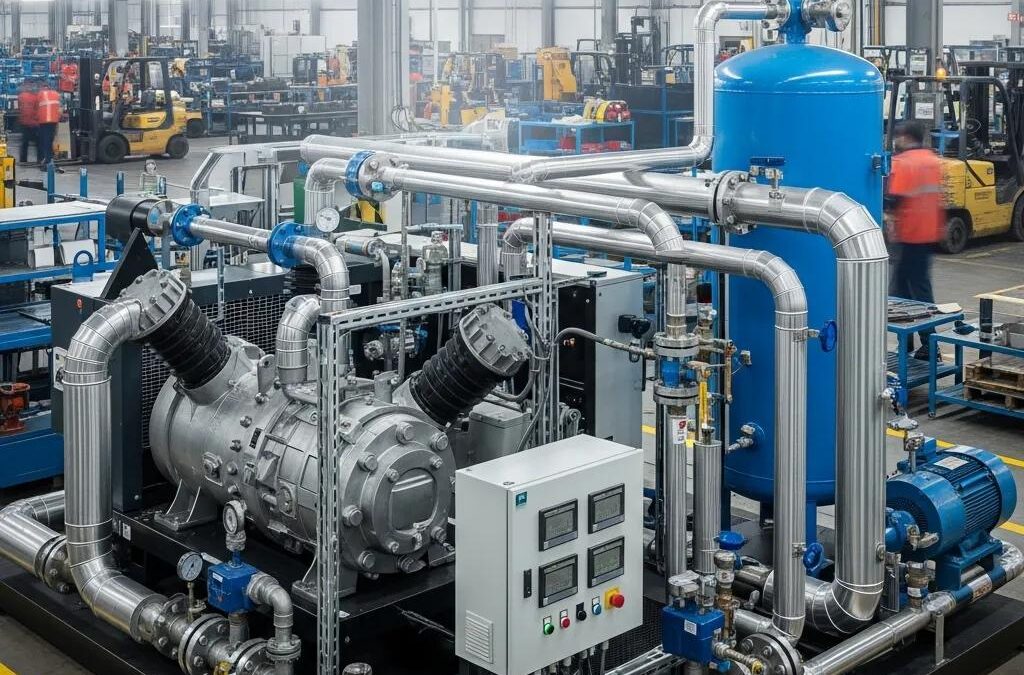
Industrial High-Pressure Air Compressor Systems: Applications and Solutions for Manufacturing and Energy Sectors
Please note: The content presented here is intended to provide conceptual frameworks and design principles related to high-pressure compressor systems. It is not intended as licensed engineering guidance, design specifications, or a substitute for professional engineering advice. Specific applications require detailed engineering analysis and adherence to all applicable codes and standards.
Industrial high-pressure air compressor systems compress and deliver gas at pressures significantly above standard plant pneumatic levels to power specialized machinery, perform pressure testing, and handle fuel compression tasks. These systems operate through multi-stage compression, intercooling, and precision valving to maintain stable delivery pressure and meet purity or safety requirements, which yields predictable process outcomes and reduced downtime. Understanding how continuous-duty designs, oil-free options, and application-specific accessories interact provides a framework for optimizing compressed air systems in manufacturing, CNG fueling, and energy-sector gas handling. This article explores core compressor types, component roles, manufacturing applications, and energy-sector uses, presenting conceptual frameworks for selection criteria, maintenance considerations, and energy-efficiency technologies. This discussion outlines conceptual implementation patterns for manufacturing compressed air systems, explores how CNG and biogas compression supports renewable fuels and vehicle fueling, and identifies accessory types—such as purification modules, boost pumps, and air amplifiers—that are integral for system integrity and throughput. The discussion integrates vendor capabilities sparingly to illustrate real-world solutions, focusing on conceptual technical considerations for professionals involved with industrial high-pressure compressor systems.
What Are Industrial High-Pressure Air Compressors and Their Key Benefits?
Industrial high-pressure air compressors are mechanical systems designed to raise the pressure of air or gas to levels typically required for specialty applications, often ranging from tens up to several hundred bar depending on the task. They achieve this through staged compression, intercooling, and robust mechanical design, providing stable, high-pressure delivery that enables reliable actuation, pressure testing, and filling operations across sectors. The main benefits include sustained uptime from continuous-duty capability, precise pressure control for process consistency, and enhanced safety and purity when paired with proper filtration and monitoring. In manufacturing and energy contexts, these attributes can contribute to reduced process variability, shorter cycle times, and support for regulatory compliance, particularly for specialized applications like breathing air or fuel-grade gas. The next subsection explains how continuous-duty compressors offer operational advantages and which engineering features make them suitable for nonstop industrial use.
How Do Continuous-Duty High-Pressure Compressors Enhance Industrial Operations?
Continuous-duty high-pressure compressors are engineered to run without frequent cool-down periods by using lower RPM components, robust cast blocks, and thermal management strategies that dissipate heat effectively during prolonged operation. This design reduces thermal stress on key components, maintains steady pressure delivery, and minimizes the risk of unplanned stops—improving overall equipment availability for critical manufacturing lines and fueling stations. Continuous operation also means fewer start/stop cycles, which decreases wear on valves and seals and lengthens maintenance intervals compared with intermittent-duty machines. For operations prioritizing uptime, continuous-duty designs offer a conceptual framework for predictable scheduling and smoother integration with storage tanks and downstream purification stages. Understanding these benefits highlights why customization is often a key consideration for aligning continuous-duty compressors with specific site constraints and purity requirements.
What Makes Custom High-Pressure Compressor Solutions Essential for Manufacturing and Energy?
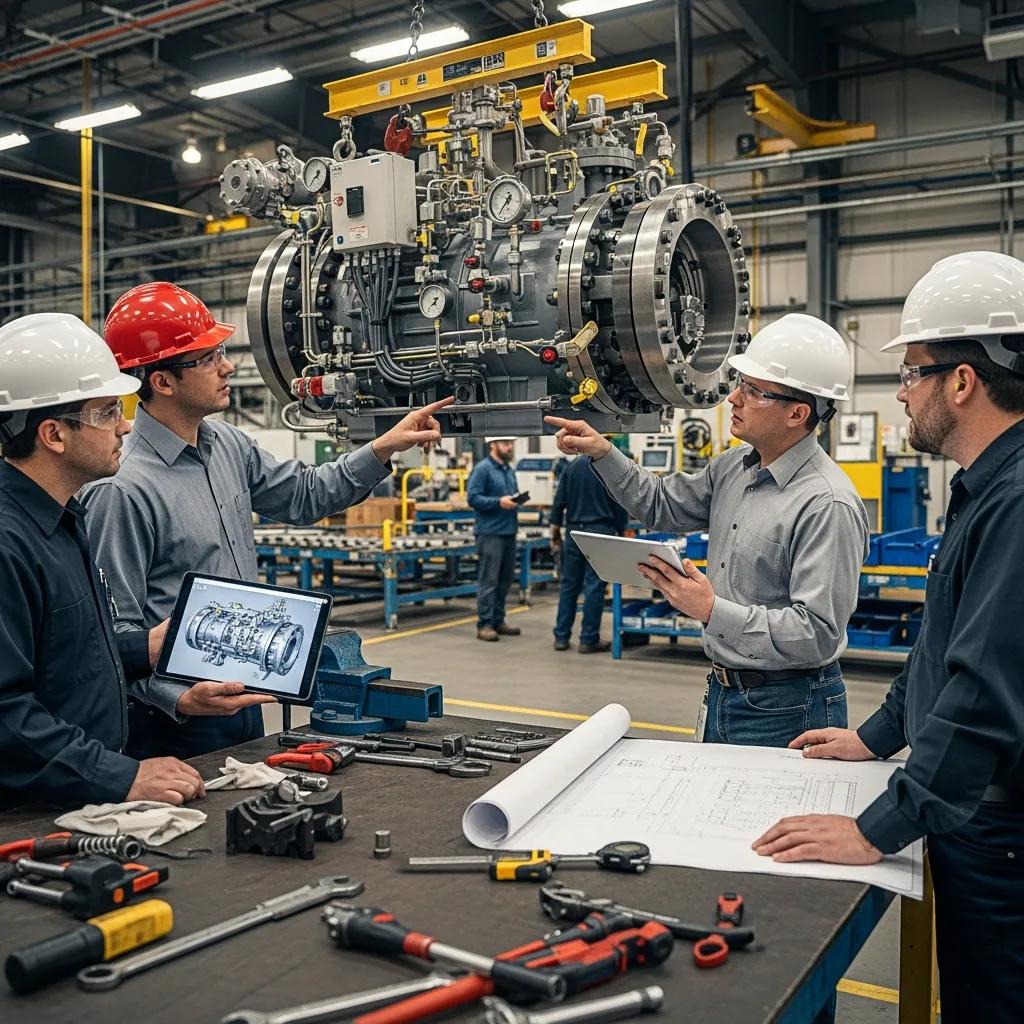
Off-the-shelf compressors may not meet unique requirements for footprint, purity, pressure staging, or integration with existing plant controls, so custom solutions adapt core compressor designs to site-specific constraints and performance targets. A project-managed custom solution often involves stages such as requirements capture, compressor selection, engineering design, packaging, and site support, aiming to ensure the final system aligns with the operational and regulatory environment. Tailored systems can improve lifecycle cost and regulatory compliance by optimizing component selection and service access, which reduces downtime and simplifies maintenance planning. The decision checklist below presents considerations for determining when a custom approach might be preferred over a standard packaged unit.
- Conceptual considerations for custom compressor solutions:
- Space-constrained installations: When footprint or mounting orientation is non-standard.
- Strict purity or breathing-air needs: When integrated inline purification and monitoring are critical design elements.
- Process integration requirements: When controls, piping, or storage need bespoke interfaces.
Such a checklist can assist in prioritizing customization, and the following section compares major compressor families to inform initial selection considerations.
Which High-Pressure Compressor Types Are Best Suited for Manufacturing and Energy Applications?
Choosing the right compressor type depends on required pressure range, duty cycle, contamination sensitivity, and lifecycle costs; common families include reciprocating (piston), rotary screw, and specialized high-pressure piston assemblies for extreme pressures. Each family delivers different trade-offs in efficiency, maintenance cadence, footprint, and suitability for oil-free operation, making a structured comparison useful for selection decisions. Below is a compact comparison that maps compressor type attributes to typical use cases and operational considerations, providing a conceptual framework for professionals.
Different compressor types offer characteristic trade-offs useful during system selection.
It’s important to note that while some specialized reciprocating and compact units can reach pressures up to 420 bar, this represents the upper end of the spectrum for specific high-pressure applications, not a typical range for all industrial compressors. This comparison clarifies that reciprocating designs excel where very high pressures or compact high-pressure packages are required, while rotary screw units suit continuous plant air at moderate pressures. The next subsections explain advantages and trade-offs across these families and the role of oil-free design for contamination-sensitive industries.
What Are the Advantages of Reciprocating and Rotary Screw Compressors?
Reciprocating compressors deliver high discharge pressures in compact packages and are well-suited for intermittent high-pressure fills and testing operations because each piston stage produces substantial pressure increase per stroke. They typically have higher peak efficiency at high pressures but may require more frequent valve and seal maintenance compared with rotary screw machines, which trade slightly lower peak efficiency for smoother operation and fewer vibration-related issues. Rotary screw compressors offer continuous-duty reliability with simpler vibration profiles and often integrate well with variable speed drives for energy savings on variable flow applications. Design principles often suggest reciprocating machines for extreme pressure or compact mobile systems, while rotary screws are typically considered for steady, high-volume plant compressed air where lower maintenance frequency and reduced vibration are priorities. These trade-offs point to oil-free considerations discussed next, particularly for breathing air and medical uses.
How Do Oil-Free and Continuous-Duty Compressors Improve Efficiency and Safety?
Oil-free compressors are designed to mitigate oil carryover risk into the compressed air stream, supporting compliance with purity standards, particularly those referenced in industry guidance for applications like breathing air and sensitive manufacturing processes. The mechanism is simple: oil-free designs use materials and clearances that avoid oil lubrication in the compression chamber or rely on separation stages that prevent contamination, protecting downstream processes and product quality. Continuous-duty capability complements oil-free design by maintaining stable temperatures and pressures that can reduce condensation and microbial growth risks in compressed-air networks. For regulated applications such as medical gas, food processing, and breathing air, the combination of oil-free compression with effective purification and monitoring is a critical design consideration for ensuring safety and compliance. Having considered compressor families and purity choices, the following section explores concrete manufacturing applications and system design patterns.
How Are High-Pressure Systems Applied in Manufacturing Compressed Air Solutions?
High-pressure air systems in manufacturing power specialized equipment, enable high-precision testing, and provide process air for material handling, cutting, and automated tooling; the design must balance pressure, flow, storage, and purity. Typical system architectures include a high-pressure compressor, intercooler and aftercooler stages, purification modules, storage receivers, and controlled distribution piping with safety valves and monitoring. Conceptual design for manufacturing often involves addressing transient loads—such as rapid pressure swings during press or test rig cycles—and may incorporate storage and boost pumps to buffer demand and sustain pressure during peaks. Below is a focused list of primary manufacturing applications and approximate pressure ranges, intended to assist in conceptually matching compressor selection to use-case requirements.
Primary manufacturing applications and their pressure profiles include the following.
- Manufacturing uses of high-pressure air:
- Pneumatic presses and actuators: Typically require 6–40 bar for high-force applications, and sometimes higher for specialized presses.
- Pressure testing and leak detection: Often use 100 bar, with specialized applications reaching up to 420 bar depending on vessel rating and test standard.
- Cleaning and material handling (blow-off, pneumatic conveyors): Use 6–10 bar for general tasks and higher pressures for dense material transport.
These applications illustrate the importance of integrated design—conceptually matching compressor capacity, storage, and downstream purification—and the next subsection highlights how custom packaged solutions can address these manufacturing challenges.
What Are the Primary Manufacturing Uses of High-Pressure Air Compressors?
Manufacturing environments rely on high-pressure air for actuation of heavy tooling, precision pressure testing of welded assemblies, and high-velocity cleaning or cutting processes that require consistent pressure and pulsation control. Pressure testing of fittings, cylinders, and safety devices may demand pressures approaching the compressor’s upper rating, a scenario that conceptually requires robust staging and safety systems to mitigate overpressure risks. Material handling and pneumatic conveyance benefit from booster stages or air amplifiers to increase flow at point-of-use without overtaxing the main compressor, enhancing throughput while limiting upstream cycling. These practical uses underscore the importance of appropriate sizing, storage, and accessory selection for maintaining efficiency and safety, leading into a short vendor-focused callout illustrating how tailored solutions can contribute.
How Do LW Americas’ Custom Solutions Address Manufacturing Challenges?
LW Americas offers continuous-duty high-pressure compressor systems and tailored project management, aiming to align compressor selection with manufacturing needs while emphasizing system durability through design choices such as one-piece cast blocks and lower RPM operation. Their approach encompasses coordination of compressor selection, and providing 2D/3D design drawings and packaging options that can simplify mechanical integration in various operational environments. By combining engineered packaging with responsive North American support and accessories—such as purification modules, filling devices, and boost pumps—these solutions are designed to reduce installation time and help ensure the delivered package addresses purity and footprint requirements. This vendor-level capability illustrates how a managed custom workflow can shorten specification cycles and reduce integration risk, transitioning naturally to energy-sector compression roles discussed next.
What Roles Do CNG Compressor Systems Play in Energy Sector High-Pressure Gas Applications?
CNG and biogas compressor systems enable conversion of low-pressure gas into high-pressure forms suitable for vehicle fueling, pipeline injection, and storage, supporting both conventional natural gas and renewable natural gas (RNG) value chains. These systems typically use multi-stage reciprocating compression with intermediate cooling and cleanup stages to handle variable gas quality and ensure the compressed fuel meets fueling or grid injection specifications. It is crucial to note that while the principles of compression are similar, systems handling natural gas or biogas require specific material selection, safety features, and design modifications compared to those used for air, due to the distinct chemical properties and potential hazards of these fuel gases. Key system design considerations include gas purification upstream of compression, materials compatibility for biogas constituents, and efficient thermal management for controlling discharge temperatures and lubricants. The next subsection describes how CNG and biogas compressors integrate into fueling infrastructure and renewable gas handling workflows.
How Do CNG and Biogas Compressors Support Renewable Energy and Vehicle Fueling?

Compressors specifically designed for CNG and biogas convert produced or farmed biogas and RNG into pressurized fuel for CNG vehicles or pipeline injection, often in staged compression steps to reach 200–250 bar for vehicle cylinders or pipeline pressure specifications. Unlike air compressors, these systems require specialized components and safety protocols to handle flammable and corrosive gas mixtures. Integration with gas cleanup and moisture removal is a critical design consideration to mitigate corrosion, hydrate formation, and particulate fouling that can compromise seals and valves; when treating biogas, material selection and filtration approaches often need to address siloxanes and other contaminants. Operational considerations include intermittent versus continuous fueling demand, storage sizing, and site-level heat recovery to improve overall plant efficiency. Properly designed CNG compressor systems conceptually link renewable gas sources to end-use markets, and the next vendor-focused subsection highlights product attributes that can support energy efficiency.
What Are the Benefits of LW Americas’ High-Pressure Compressors for Energy Efficiency?
LW Americas’ continuous-duty, lower-RPM compressor designs and one-piece cast block construction contribute to durability and reduce mechanical losses that can translate into energy and lifecycle advantages for CNG and biogas applications. When paired with integrated project management and responsive support, these design attributes aim to ensure the compressor is sized and staged appropriately, which can mitigate throttling and part-load inefficiencies often associated with poorly matched systems. The company’s product range—covering mobile, compact, stationary, and silent units, with specialized models reaching up to 420 bar—provides options for fueling stations, mobile fueling units, and pipeline boosting where energy performance and uptime are priorities. These vendor capabilities illustrate how CNG and biogas equipment selection and system-level design conceptually interact to impact efficiency, moving the discussion next to components and accessories that can optimize performance.
Which Components and Accessories Optimize High-Pressure Compressor System Performance?
A high-pressure compressor package is only as effective as its supporting components: purification systems, breathing air monitoring, filling devices, boost pumps, storage tanks, valves, and safety accessories all shape safety, purity, and throughput. Purification stages are designed to remove oil, particulates, moisture, and hydrocarbons to meet application-specific purity targets. Separately, breathing air monitors provide continuous verification for safety-critical air supplies, a distinct and highly regulated application. Boost pumps and filling devices manage flow and pressure at point-of-use, reducing main compressor cycling and improving fill rates, and air amplifiers can increase localized pressure for short-duration tasks without oversized main compressors. The table below clarifies component functions, typical benefits, and common specifications, offering a conceptual framework for system designers to consider which accessories to incorporate.
Key components and their roles in system performance.
How Do Purification Systems and Breathing Air Monitoring Enhance Safety and Quality?
Purification systems typically combine coalescing filters, dryers, activated carbon, and adsorbents to remove oil vapor, moisture, and hydrocarbons to meet application-specific purity targets, and their selection depends on inlet air quality and required ISO 8573-1 classes. Breathing air monitoring complements purification by tracking oxygen levels, CO, hydrocarbons, and particulate concentrations, triggering alarms and interlocks when readings exceed safe thresholds. The conceptual placement of monitors is often considered critical—typically after final filtration but before distribution—to help ensure that any degradation in purification performance is detected prior to user exposure. For regulated breathing-air duties and sensitive manufacturing, combining multi-stage purification with continuous monitoring is a key design principle for supporting compliance and operator safety, which naturally brings attention to boost pumps and filling devices that can enhance operational flexibility.
What Are the Functions of Filling Devices, Boost Pumps, and Air Amplifiers?
Filling devices and boost pumps raise pressure locally to speed vessel fills or maintain pressure during peak demand, reducing the need to oversize the main compressor and smoothing transient loads on the plant system. Air amplifiers use the Venturi effect or staged boosting to increase localized pressure for short-duration tasks, offering a cost-effective alternative where continuous high pressure is unnecessary. Conceptual integration often involves check valves, pressure relief mechanisms, and monitoring to mitigate backflow or overpressure conditions. Maintenance frameworks typically recommend routine inspection of seal integrity and flow paths. The selection of these accessories, based on duty cycle and fill-rate requirements, can contribute to improved throughput and reduced wear on core compression equipment. The next section covers energy-efficiency measures and maintenance practices that extend equipment life.
How Can Energy Efficiency and Maintenance Practices Extend the Life of High-Pressure Compressors?
Proactive energy-efficiency measures and structured maintenance programs reduce operating costs and extend compressor life by minimizing stress, optimizing control, and catching wear patterns early through monitoring. Technologies like variable speed drives (VSDs), heat recovery systems, and IoT-enabled condition monitoring deliver quantifiable savings and predictive maintenance insights while introducing implementation considerations such as control complexity and payback timelines. Routine maintenance—filter changes, vibration analysis, oil and seal inspections, and scheduled overhauls—prevents performance degradation and avoids catastrophic failures that lead to long downtimes. The table below compares efficiency technologies by expected energy impact, maintenance benefits, and implementation considerations, offering a conceptual framework for decision-makers to balance ROI and operational readiness.
Efficiency technologies compared for decision-making.
What Are Best Practices for Maintaining Continuous-Duty High-Pressure Compressors?
A robust maintenance framework for continuous-duty compressors often encompasses monthly visual and operational checks, quarterly filter and oil-level verification (if applicable), and annual vibration and thermal analysis to identify early signs of wear. Predictive maintenance focuses on monitoring temperature, vibration spectra, and oil condition (when present) to schedule interventions before failures occur; maintaining a critical-spares list for valves and seals shortens repair times. Documentation of running hours and load patterns can inform overhaul timing and support the conceptual justification for investments in upgrades like VSDs or enhanced cooling. Implementing these practices can contribute to reduced unplanned downtime and extended component life, which supports broader energy-efficiency considerations discussed next.
How Do Energy-Efficient Technologies Reduce Operational Costs in Industrial Settings?
Energy-efficient technologies such as VSDs, heat recovery, and IoT monitoring deliver measurable operational savings by matching compression output to demand, reusing waste heat for plant processes, and enabling early fault detection to avoid inefficient operation. VSDs reduce energy consumption during partial-load operation by adjusting motor speed to demand, offering significant savings depending on duty profile, while heat recovery can offset process heating loads and shorten payback on larger installations. IoT monitoring reduces lifecycle costs by optimizing maintenance scheduling and reducing catastrophic failures, though it requires upfront sensor and analytics investment. Balancing these options against implementation complexity and expected ROI provides a conceptual framework for achieving sustained cost reductions and reliability. For teams seeking vendor support for design, drawings, and delivery, LW Americas offers project-managed compressor solutions, including custom 2D/3D drawings and support for system integration.
- Operational savings: VSDs and heat recovery lower net energy costs through demand matching and reuse of thermal energy.
- Maintenance savings: IoT monitoring reduces downtime and extends component life by enabling predictive repairs.
- Implementation trade-offs: Upfront costs and control complexity must be weighed against lifecycle savings and reliability goals.
Explore Tailored High-Pressure Solutions
For specific quotes, custom designs, 2D/3D drawings, and project-managed compressor selection, connect with LW Americas for tailored high-pressure solutions and responsive North American support.