

Unlock Efficiency With L&W Compressor Systems: Optimize High-Pressure Continuous Duty Performance
In the realm of industrial air systems, optimizing high-pressure continuous duty performance is crucial for enhancing operational efficiency and reducing downtime. This article delves into the key features and benefits of L&W compressor systems, providing insights into how they can transform your operations. Readers will learn about the innovative designs, energy-saving technologies, and tailored solutions that L&W offers to meet diverse industrial needs. Many businesses face challenges related to compressor efficiency, leading to increased operational costs and downtime. L&W compressor systems present a solution through their advanced engineering and customer support. This guide will explore the key features of L&W compressors, their energy efficiency capabilities, custom solutions for specific industries, maintenance practices for longevity, and the practical applications that highlight their efficiency benefits.
Optimize High-Pressure Continuous-Duty Efficiency with L&W Systems
The key features of L&W Continuous-Duty High-Pressure Compressors include:
- Continuous Operation: Designed for extended operation without frequent cool-down periods, contributing to enhanced uptime in suitable applications.
- Robust Mechanical Design: Utilizes lower RPM components and one-piece cast blocks for durability and reduced leak potential.
- Thermal Management: Incorporates strategies to manage heat effectively during operation, crucial for sustained performance.
- Telemetry Ready: Supports monitoring of performance metrics like FAD (Free Air Delivery), motor current, and vibration, enabling proactive maintenance and specification validation.
- Custom Engineering Support: Offers tailored solutions for specific operational needs, including pressure, flow, and duty cycle, ensuring application-specific optimization.
- North American Support: Provides local assistance for installation and maintenance, enhancing serviceability.
- Advanced Control Features: Includes options like Electronic Compressor Control (ECC) for automatic operation and monitoring capabilities.
These features are designed to make them suitable for critical applications requiring sustained high-pressure fills and robust uptime.
The robust design and continuous operation of L&W compressors align with broader industry insights on high-pressure continuous duty systems.
High-Pressure Continuous Duty Scroll Compressor Performance
As a hermetic compressor designed for use with high-pressure refrigerants, the scroll compressor offers a compact, lightweight, and efficient solution. These compressors are designed for continuous duty and long life, making them suitable for demanding industrial applications. Overall, hermetic scroll air compressor performance is enhanced by these design considerations.
A hermetic scroll compressor for application to high, 2003
How Does the One-Piece Cast Block Design Enhance Compressor Durability?
The one-piece cast block design enhances compressor durability by improving mechanical integrity and reducing the potential for leaks. This design minimizes the number of joints and connections, which are often points of failure in compressors, thereby increasing reliability and longevity.
Why Does Lower RPM Operation Improve Efficiency and Reduce Wear?
Lower RPM operation improves efficiency and reduces wear by minimizing friction and heat generation within the compressor. This leads to less wear and tear on components, ultimately extending the operational life of the compressor and reducing maintenance needs.
How Do L&W Compressor Systems Achieve Energy Efficiency and Cost Savings?
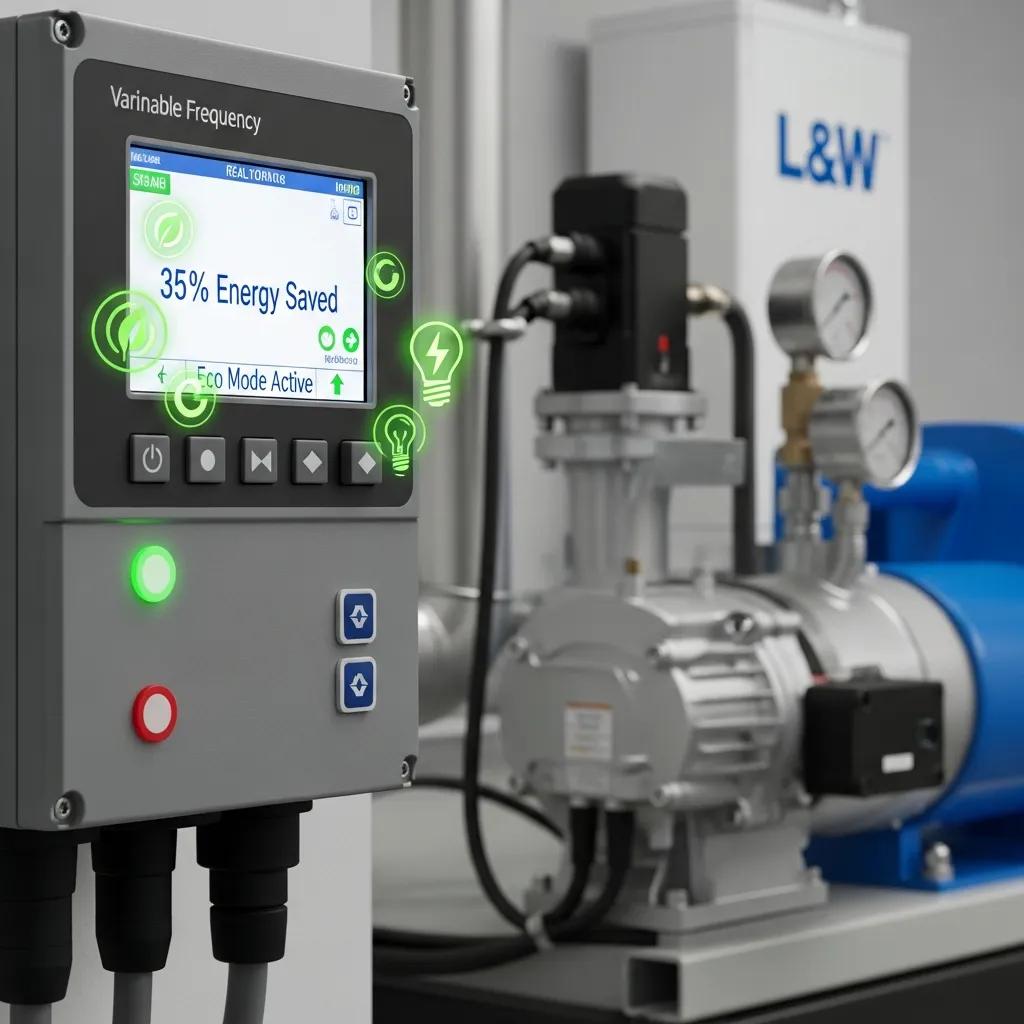
L&W Compressor Systems achieve energy efficiency and cost savings through several key features:
- Variable Frequency Drive (VFD): This technology reduces the inrush current when starting the electric motor, potentially leading to significant energy savings depending on the duty cycle.
- Automated Operation: The systems are designed to automatically stop when tanks are full, optimizing energy consumption.
- Continuous-Duty Design: Their compressors are built for continuous operation, which, when properly applied, can enhance reliability and reduce maintenance needs, contributing to cost savings over time.
- Monitoring and Telemetry: By analyzing telemetry trends, operators can detect issues before they lead to failures, facilitating proactive maintenance and potential downtime reduction.
- Optimized Mechanical Design: Features like one-piece cast blocks improve durability and reduce leak potential, contributing to lower operational costs.
These elements combined help in reducing energy usage and maintenance costs, ultimately leading to significant savings for users.
Further emphasizing the importance of such technologies, research highlights the critical role of Variable Frequency Drives in achieving significant energy savings for industrial air compressors.
Variable Frequency Drives for Industrial Air Compressor Energy Savings
Air compressors have the problem of high energy consumption and high operating costs, which seriously restricts the development of the hydrogen fuel cell industry. Therefore, it is necessary to apply variable-frequency drive (VFD) to control the operation of HFC air compressors, and the application status of VFD in HFC air compressors is reviewed in this paper.
Application status of variable-frequency drive in hydrogen fuel cell air compressors from an industrial viewpoint: A review, X Guo, 2024
What Role Does Continuous-Duty Operation Play in Reducing Downtime?
Continuous-duty operation can play a crucial role in reducing downtime by enabling longer run times with predictable maintenance intervals when integrated into a well-planned maintenance strategy. This is achieved through the use of robust mechanical components and optimized cooling strategies, which allow compressors to sustain continuous operation without thermal compromise. As a result, applications that previously required complex setups can now aim for higher uptime with fewer, more efficient units. This shift emphasizes lifecycle cost and serviceability, ultimately aiming for reduced maintenance frequency and improved reliability for critical systems.
How Can Smart Controls Optimize Energy Consumption in L&W Systems?
Smart controls are designed to optimize energy consumption in L&W systems by leveraging technology trends such as variable-speed drives, enhanced designs, and IoT for predictive maintenance. These innovations can lead to more efficient operation, potentially reducing the operating cost per delivered cubic foot and enabling longer continuous operation without thermal issues under optimal conditions. Additionally, smarter monitoring provides telemetry that helps transition from reactive to predictive service models, ultimately improving total cost of ownership and uptime guarantees.
Further research highlights the growing importance of advanced technologies like machine learning and IoT in enhancing predictive maintenance strategies for industrial compressors.
Predictive Maintenance for Industrial Air Compressors
In the era of Industry 4.0, predictive maintenance has become a cornerstone for ensuring operational efficiency, minimizing downtime, and extending the lifespan of industrial equipment. This paper presents a comprehensive approach to predictive maintenance and real-time monitoring of industrial air compressors using machine learning techniques integrated with Internet of Things (IoT) infrastructure.
Predictive Maintenance and Monitoring of Industrial Compressors Using Machine Learning: A Proactive Approach, P Dwivedi, 2025
Building on this, further studies underscore the practical application of machine learning with real-world data to enhance predictive maintenance systems for industrial compressors.
Machine Learning for Compressor Predictive Maintenance & Efficiency
Maintaining the operational efficiency and reliability of any industrial system is mandatory to minimize downtime and prevent failures. For this purpose, forecasting the evolution of key operational parameters such as temperature is essential. Whereas many studies are based on benchmark datasets, this work is based on real sensor data collected from industrial screw compressors to make maintenance planning relevant to the real world. The proposed framework is designed to be computationally efficient and scalable for real-time application on industrial edge devices.
Predictive maintenance system for screw compressors using machine learning: A comparative study, 2025
Which Custom L&W Compressor Solutions Are Available for Industry-Specific Needs?

The available Custom L&W Compressor Solutions for industry-specific needs include:
- Primary pressure calibration to adjust desired inlet pressure.
- Inlet buffer tank (150 l) with safety valve, manual condensate drain valve, pressure gauge, and electrical cut-off solenoid for inlet gas.
- Primary pressure monitoring with pressure shut off at max/min inlet pressure.
- Electronic Compressor Control (ECC) for auto start in semi/full automatic mode.
- Inter-stage pressure gauge and oil pressure gauge with monitoring and auto shut down.
- Puracon filter monitoring.
- Compressor block heating for ambient temperatures below +5°C.
- Options for 420 bar versions and water cooling with stainless steel heat exchangers.
- Filter extension (larger or second filter housing).
These solutions are designed to meet specific operational and regulatory requirements, aiming for optimal performance and reliability in various applications.
How Are L&W Compressors Tailored for Diving and Firefighting Applications?
L&W Compressors are tailored for diving and firefighting applications through features that ensure high-pressure delivery, continuous operation, and safety.
For diving, the YachtPro™ Essential (YP100) compressor system automates tank filling, allowing users to focus on other tasks while ensuring tanks fill to the desired pressure within system capabilities. It includes a Variable Frequency Drive (VFD) to manage inrush current and operates efficiently in marine environments.
For firefighting, the SCBA fill station integrates high-pressure compressors with multi-stage purification and storage tanks, providing reliable on-site access to breathing air that is designed to meet health and safety standards. Continuous-duty compressors can support rapid cylinder refills, contributing to enhanced crew readiness and operational efficiency. Additionally, integrated air quality monitoring helps ensure the safety of the air being supplied.
What Custom Solutions Support Medical and Industrial Air System Efficiency?
LW Americas’ custom solutions support medical and industrial air system efficiency through continuous-duty high-pressure compressor systems, tailored project management, and custom engineering. They provide sizing and project management services, including 2D/3D design drawings and packaging options, to ensure that compressor selection aligns with specific manufacturing needs. Their offerings include purification modules, filling devices, and boost pumps, which are designed to enhance system integrity and throughput. Additionally, their focus on energy efficiency and continuous-duty architectures aims to contribute to improved operational performance in various applications.
How Can Maintenance and Longevity Practices Maximize L&W Compressor Efficiency?
Maintenance and longevity practices can maximize L&W compressor efficiency by implementing structured maintenance schedules, monitoring system performance, and ensuring proper operational conditions. Key practices include:
- Regular Inspections: Conduct daily visual inspections and weekly checks for oil levels and leaks to catch issues early.
- Scheduled Maintenance: Follow a structured maintenance matrix that includes filter replacements and annual overhauls based on manufacturer recommendations and usage patterns.
- Telemetry Monitoring: Utilize telemetry to track performance metrics like FAD (Free Air Delivery) and motor current, allowing for proactive adjustments to duty cycles and scheduling of services before failures occur.
- Environmental Considerations: Adjust for environmental factors such as altitude and temperature that can affect compressor performance, ensuring optimal conditions for operation.
- System Design: Choose compressors with durable designs, such as one-piece cast blocks, and incorporate features like variable-speed drives to enhance efficiency and reduce wear.
By adhering to these practices, operators can significantly improve uptime, maintain efficiency, and extend the lifespan of their compressors when implemented consistently.
What Preventative Maintenance Ensures Continuous Operation?
Preventative maintenance that aims to ensure continuous operation includes routine checks such as monthly visual and operational inspections, quarterly filter and oil-level verifications, and annual vibration and thermal analyses. Predictive maintenance, which focuses on monitoring temperature, vibration spectra, and oil condition, is also crucial for scheduling interventions before failures occur. Additionally, maintaining a critical-spares list for valves and seals can help shorten repair times and minimize downtime.
Why Are Genuine L&W Spare Parts Critical for Sustained Performance?
Genuine L&W spare parts are critical for sustained performance because they ensure reliability and compatibility with the equipment, which is essential for maintaining operational efficiency and safety. Using genuine parts is crucial as it helps reduce the risk of failure, minimizes maintenance frequency, and supports compliance with adopted standards. This is particularly important in life-safety infrastructure, where performance and reliability are paramount. Additionally, genuine parts are designed to work seamlessly with the systems, contributing to predictable maintenance costs and overall uptime.
What Are the Practical Applications and Efficiency Benefits of L&W High-Pressure Systems?
The practical applications and efficiency benefits of L&W high-pressure systems include:
- Automated Operation: The YachtPro™ Essential compressor system allows users to fill tanks automatically, freeing them to attend to other tasks while ensuring tanks fill to the programmed pressure within system specifications.
- Continuous-Duty Performance: The systems are designed for sustained high-pressure fills, which is essential for applications like breathing-air systems and industrial operations where continuous performance is critical.
- Telemetry and Monitoring: The ability to analyze telemetry trends helps operators detect issues before failures occur, facilitating proactive maintenance and contributing to improved uptime.
- Custom Engineering Support: LW Americas offers tailored solutions that combine appropriate pressure, flow, and duty cycle with monitoring, designed to enhance operational efficiency.
- Durability and Reliability: The use of one-piece cast blocks improves durability and reduces leak potential, aiming to contribute to long-term reliability.
- Customer Support: Comprehensive customer support throughout the lifecycle of the compressors is provided to help ensure optimal performance and maintenance, thereby enhancing overall efficiency.
How Do L&W Compressors Improve Breathing Air Quality in Maritime and Offshore Settings?
L&W Compressors improve breathing air quality in maritime and offshore settings by utilizing multi-stage purification systems that filter contaminants from the ambient air before it is compressed. This is designed to ensure that the compressed air meets health and safety standards, which is critical for applications such as filling SCBA cylinders. The compressors are designed for continuous-duty operation, providing reliable access to high-quality breathing air while aiming to minimize the risks associated with using off-site fills. Additionally, integrated air quality monitoring helps detect potential contamination, enhancing safety and operational readiness.
What Efficiency Gains Do CNG, Biogas, and Motor Sports Industries Experience?
L&W compressor systems are engineered to provide significant efficiency gains across various industries, including representative use cases such as CNG, biogas, and motorsports. These systems are designed to optimize gas compression processes, which can lead to reduced energy consumption and lower operational costs when properly implemented. In the CNG sector, for instance, L&W compressors can facilitate faster refueling times and improved gas quality, which are essential for meeting stringent regulatory standards. Similarly, in biogas applications, the efficiency of L&W compressors can enhance the overall energy yield from organic waste, making them a sustainable choice for energy production. In motorsports, the reliability and performance of L&W compressors are utilized to help teams maintain optimal air pressure in tires and other systems, potentially impacting race performance.