
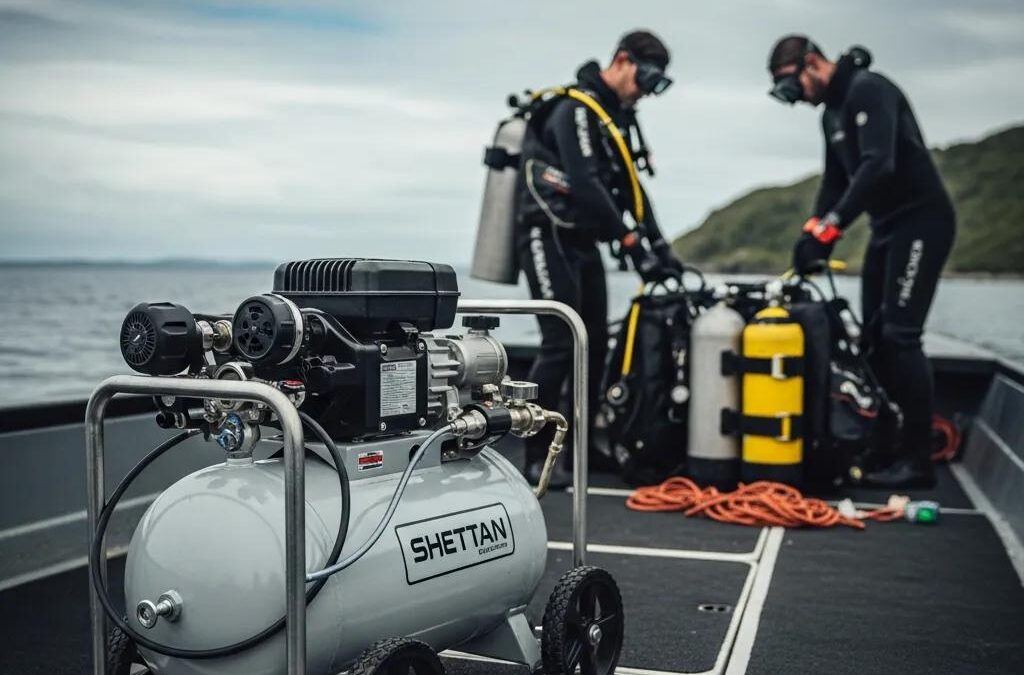
Portable Dive Compressor Systems – Mobile Solutions for Remote and Field Operations: Comprehensive Guide to High-Pressure Scuba Compressors
Portable dive compressor systems deliver on-site, high-pressure breathing air so teams can fill scuba cylinders and support diving operations away from fixed shore infrastructure. This guide explains what portable and mobile compressor systems are, why continuous-duty high-pressure units matter in remote field work, the types of portable compressors available, key technologies and breathing-air purification standards, how to choose the right system, and best practices for maintenance and operation. Readers will gain actionable decision criteria—portability, power source, fill rate, and air quality—and structured checklists to match mission profiles to appropriate equipment. The article integrates examples of vendor capabilities where helpful and points to practical next steps for procurement and support. By the end, technical leads and field operators will understand how to plan power and logistics, verify breathing-air quality to standards, and operate compressors reliably in remote, maritime, and emergency-response contexts.
What Are Portable Dive Compressor Systems and Their Importance in Remote Operations?
A portable dive compressor system is a mobile high-pressure compressor and associated filtration/controls designed to produce breathing air on-site for scuba cylinders and other life-support uses. These systems combine a compression module, multi-stage filtration, control panel, and a powertrain optimized for field transport and rapid commissioning, enabling teams to deliver CGA Grade E–equivalent air where shore fills or cylinder logistics are impractical. The principal operational benefit is logistical independence: teams can stage dives from vessels, remote islands, offshore platforms, wildfire staging areas, or disaster-response zones without relying on cylinder resupply. Understanding these capabilities helps planners align equipment choices with mission constraints such as transport method, service interval, and environmental exposure.
Defining portable dive compressors and mobile breathing air systems
Portable dive compressors range from compact, trailer- or skid-mounted stations to crate-mounted, transportable fill stations that deliver breathing air at high pressures suitable for scuba and surface-supplied systems. Typical portable systems include a multi-stage compression block, inlet and interstage filtration, an oil-management strategy, and a control panel that may provide pressure regulation and telemetry. Pressure outputs are designed to reach scuba fill pressures (including 200–300 bar class options) and to support Nitrox blending when required. Transport considerations focus on weight, footprint, and mountings for trucks, vessels, or trailers; “portable” usually means manageable by common field logistics yet robust enough for continuous duty.
Challenges of providing breathing air in remote and field diving environments
Field operations must manage power availability, environmental contamination, condensation, and spare-parts logistics while preserving breathing-air purity and uptime. Power planning is critical because grid access is often absent; teams must prepare generator capacity, fuel strategy, or battery/inverter solutions that match compressor starting and running loads. Air purity assurance requires staged filtration, sampling, and in-field gas analysis to confirm compliance with breathing-air standards; redundancy in filters and sampling points mitigates contamination risk. Finally, servicing constraints—limited access to OEM parts or technical support—mean operators should carry critical spares and establish a maintenance cadence tied to mission length and duty cycles. These operational details lead into why continuous-duty engineering matters for sustained field work.
Common deployment scenarios for portable dive compressors include:
- Offshore and shipboard fills for commercial and research diving.
- Remote expedition staging on islands and inland water sites where cylinder resupply is unavailable.
- Emergency-response and firefighting staging where on-demand breathing air supports rescue and fire teams.
These use-cases highlight why system selection must balance portability, power independence, and air-quality controls to sustain operations across diverse environments.
How Do Continuous-Duty High-Pressure Compressors Enhance Diving Operations?
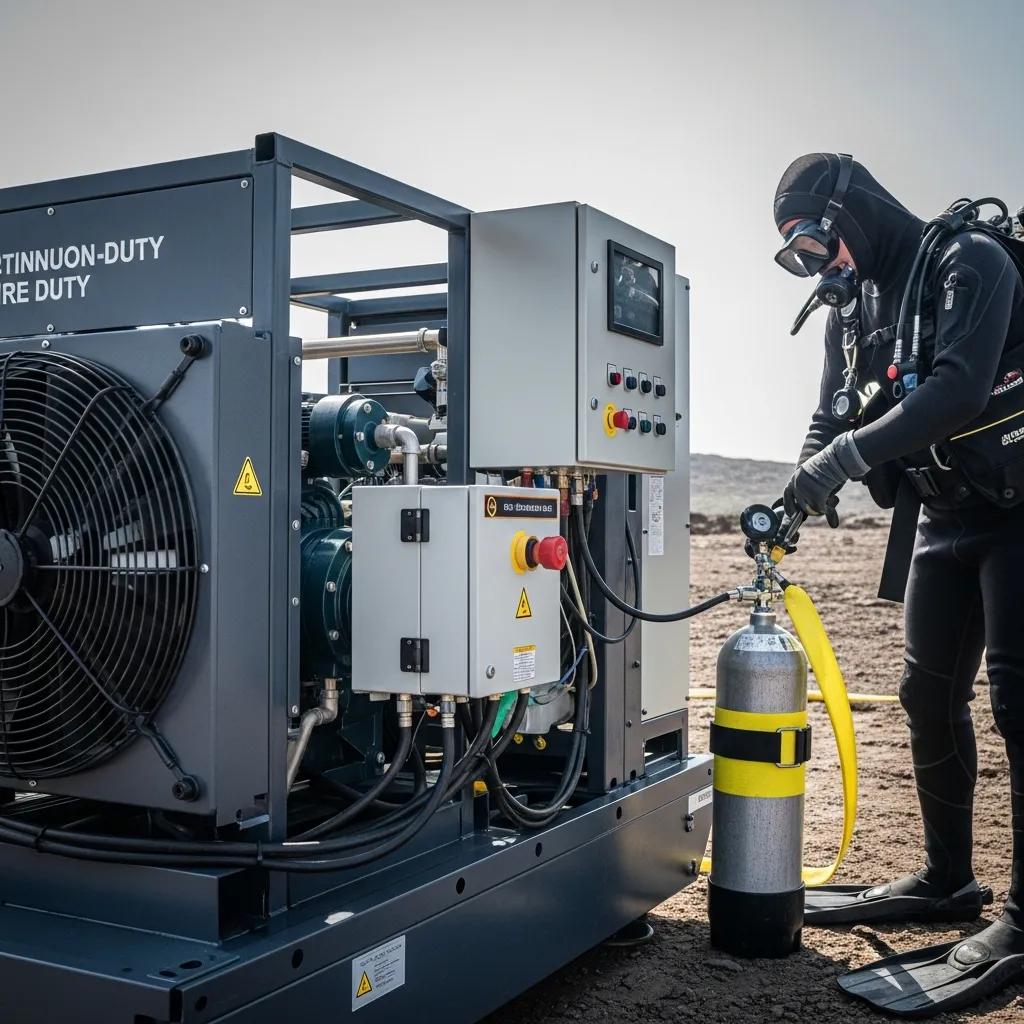
Continuous-duty high-pressure compressors are engineered to run for extended periods without the thermal or mechanical limitations that constrain intermittent units, which makes them suitable for sustained fills in remote or mission-critical scenarios. By design, continuous-duty systems maintain stable interstage temperatures, consistent oil management, and robust cooling to prevent overheating and performance degradation; the result is predictable fill throughput and fewer forced outages. Operational benefits include scheduling flexibility, the ability to support long daily fill lists, and lower logistic overhead since downtime and emergency service calls decrease. Translating engineering attributes into operational metrics helps dive supervisors plan mission timelines and spare-parts inventories.
Benefits of Continuous-Duty Operation for Uninterrupted Air Supply
Continuous-duty operation reduces the frequency of cool-down cycles, enabling uninterrupted cylinder fills during peak mission windows and supporting back-to-back operations in limited timeframes. This reliability improves throughput and reduces bottlenecks when multiple teams require fills, and it supports on-demand response in emergency or tactical deployments. In practice, continuous-duty compressors increase predictable uptime, which lowers the probability of mission delays caused by compressor thermal limits or forced maintenance. Understanding uptime advantages leads to examining the engineering choices—materials, cooling, RPM—that make continuous-duty operation possible.
Robust Engineering Features: One-Piece Cast Block and Lower RPM Advantages
A one-piece cast block integrates the cylinder bank and crankcase into a single, machined casting that reduces joint interfaces susceptible to leakage and misalignment; this meronymic relationship—parts forming a stronger whole—improves durability and simplifies sealing strategies. Lower RPM operation reduces cyclic stress, vibration, and wear on bearings and seals, which lengthens service intervals and reduces consumable replacement rates. Together, these engineering elements translate to longer lifecycle performance, quieter operation in the field, and more predictable maintenance planning for remote deployments. These design considerations map directly to operational outcomes such as fewer spare-part interventions and consistent fill rates under continuous duty.
Which Types of Portable Dive Compressors Are Best Suited for Field and Remote Use?
Selecting the right compressor type requires matching the power source, portability, and fill-rate profile to mission constraints such as vessel size, transport method, and expected daily fills. Electric portable compressors excel where shore power or reliable generator support exists and tend to be quieter with lower local emissions, making them preferable for sensitive environments. Gasoline- or diesel-powered units provide independence from grid infrastructure and are essential for off-grid deployments, though they require fuel logistics and more intensive engine-level maintenance. Hybrid configurations combine electric drive with combustion backup to deliver flexibility and redundancy in mixed-power scenarios.
Electric Portable Dive Compressors: Efficiency and Portability
Electric compressors offer high thermodynamic efficiency and reduced on-site emissions, which benefits operations where noise or exhaust is a concern, such as marinas or ecologically sensitive shorelines. They integrate well with generator sets and can leverage shore power when available, simplifying fuel logistics and reducing operating costs per fill. Limitations include dependency on a stable power source and the need to manage peak-start currents; integrating soft-starts, inverter systems, or battery buffering addresses these constraints. When operations can secure reliable power, electric units are often the preferred balance of efficiency and compactness.
Gasoline-Powered and Hybrid Compressors for Off-Grid Applications
Combustion-engine compressors deliver autonomy on long-range expeditions, remote islands, and disaster zones where fuel can be carried but grid power is absent. They require robust fuel and maintenance planning and may need emission control strategies in sensitive areas. Hybrids pair combustion engines with electric drives or battery buffering to combine independence with quieter, lower-emission operation during sensitive phases. For many off-grid missions, a hybrid configuration provides redundancy: if one power source becomes unavailable, the other can maintain critical fills. Choosing between these options depends on travel constraints, mission duration, and environmental restrictions.
This comparison helps buyers weigh portability against power independence and throughput. After choosing a power architecture, operators should plan fuel or electrical support systems tailored to mission duration and service access.
For field teams needing custom power configurations or continuous-duty systems built for remote operations, LW Americas provides North American support and customization services that align with continuous-duty design principles. LW Americas can assist with project scoping and custom engineering drawings to match specific power and mounting needs. Contacting LW Americas for a consultation helps translate mission parameters into a viable system specification and parts list.
What Are the Key Features and Technologies in High-Pressure Scuba Compressor Systems?
High-pressure scuba compressor systems combine multi-stage compression, staged filtration, monitoring, and auxiliary systems like Nitrox blending to produce safe breathing air at required part-pressure specifications. Multi-stage compression raises air to scuba and surface-supply pressures efficiently while managing interstage cooling to prevent oil carryover and thermal stress. Filtration chains—coalescing, activated carbon, and molecular sieve units—remove particulates, oil vapor, and water to meet breathing-air standards such as CGA Grade E and EN 12021. Remote monitoring, telemetry, and integrated blending options improve operational safety and allow field techs to validate air quality in real time.
Multi-Stage Compression and Breathing Air Purification Standards
Multi-stage compressors use several compression stages with intercoolers to limit discharge temperatures and segregate contaminants; this staged approach reduces the risk of oil and water carryover. Filtration chains typically include particulate/coalescing filters, activated carbon to remove hydrocarbons, and molecular sieve beds for moisture control and final gas purity. Field operators should implement a QA checklist that includes filter pressure-drop tracking, periodic oil analysis, and sample testing for hydrocarbons and moisture to confirm compliance with CGA Grade E or EN 12021. These verification steps translate component-level attributes into assured breathing-air outcomes for divers.
Integration of NitroxMaker™ and Remote Monitoring Solutions
On-site Nitrox production via NitroxMaker™-style blending enables filling enriched-oxygen mixes without separate gas cylinders, which benefits repetitive diving profiles and reduces logistical burden. Remote monitoring systems add telemetry, alerting, and predictive maintenance data that shorten service response time in remote deployments; they provide alarms for pressure, temperature, and filter saturation that help avoid inadvertent fills with out-of-spec air. The combination of on-site gas blending and remote oversight yields operational efficiencies and safety improvements, especially on long deployments or multi-shift diving operations.
How to Choose the Right Portable Dive Compressor for Your Remote Diving Needs?
Choosing the right portable dive compressor starts with a clear mission profile: expected fills per day, maximum required pressure (e.g., standard scuba vs 300 bar systems), transport constraints, and environmental considerations. Next, match the power architecture to available energy sources—shore power, generator, or fuel logistics—and verify that starting and running power requirements fit planned support systems. Prioritize breathing-air quality features and field-testable QA procedures; systems that include filter monitoring, easy filter changeouts, and accessible sample ports simplify compliance. Factoring in maintenance access and vendor support is crucial for operations far from service centers.
Checklist: Portability, Power Source, Fill Rate, and Air Quality
- Define mission throughput: Estimate tanks per day and peak simultaneous fills to size compressor capacity.
- Match power architecture: Choose electric, combustion, or hybrid based on grid access and fuel logistics.
- Specify air-quality controls: Require staged filtration, sample ports, and QA procedures aligned with CGA/EN standards.
- Plan maintenance and spares: List critical consumables and turnaround times for replacements.
- Assess transport and mounting: Confirm weight, footprint, and secure mounting options for your vessel or vehicle.
This checklist helps buyers convert operational needs into concrete specifications. After clarifying these items, compare vendors based on feature-led criteria rather than brand claims.
Comparing LW Americas’ Solutions with Competitors for Optimal Selection
When evaluating suppliers, prioritize engineering attributes such as continuous-duty designs, one-piece cast block construction, lower RPM operation, and responsive North American support. These features indicate a system built for extended field uptime and simplified maintenance. Providers offering custom project management with 2D/3D drawings make it easier to integrate compressors into compact or constrained platforms, while responsive regional support shortens service cycles. If your mission requires customized mounting, power options, or continuous-duty operation, request specification drawings and a support plan that details spare-part lists and recommended preventive maintenance intervals.
- Continuous-duty rated compression that reduces mission downtime.
- Robust mechanical design (one-piece cast block / lower RPM) to extend service life.
- Local support infrastructure and custom engineering for platform integration.
If you need procurement assistance or custom engineering for a remote-operation compressor system, contact LW Americas at (954) 462-5571 for consultative support and specification drawings to match your mission.
What Are Best Practices for Maintenance and Operation of Field Diving Compressors?
Effective field maintenance programs combine routine inspections, spares management, and commissioning checks to reduce mission risk and extend equipment life. Routine tasks include filter changes, oil-level and oil-quality checks, belt and coupling inspections, and leak tests on the pressure side. Operators should maintain a consumables kit sized to the mission duration, including filter cartridges, oil, gaskets, and a spare pressure relief valve; carrying a contingency engine or electrical starter spare is prudent for longer deployments. These practices minimize unscheduled downtime and allow teams to sustain fills in austere conditions.
Routine Maintenance Guidelines to Maximize Compressor Longevity
A structured maintenance cadence—daily, weekly, and pre/post-deployment—preserves compressor performance and air quality. Daily checks include inlet filter inspection, oil level and visible contamination checks, and a brief pressure-leak test. Weekly and pre-deployment procedures expand into filter differential-pressure recording, intercooler cleaning, and verification of telemetry/alarm functionality. Maintain spares inventory proportional to mission length: at minimum carry replacement filter elements, oil, and common fasteners. Consistent maintenance reduces risk of field failures and streamlines repair when service support is limited.
Routine maintenance tasks to perform regularly:
- Filter element replacement: Change per runtime or differential pressure indicators.
- Oil checks and changes: Monitor for contamination and adhere to recommended intervals.
- Leak and belt inspections: Detect pressure-system leaks and drive belt wear early.
- Telemetry and sensor validation: Ensure alarms and remote monitoring are functioning before missions.
Setting Up and Operating Compressors in Remote and Mobile Environments
A stepwise setup includes site prep, power hookup verification, filtration commissioning, and an initial QA fill sequence. Begin with a site survey that confirms stable mounting, ventilation, and a fuel or electrical power plan. After mechanical and electrical installation, purge and verify filtration by performing a staged sample and analyzer checks to confirm compliance with breathing-air standards prior to first use. For the first fill, perform a supervised fill with gas sampling at fill pressure and manifold points; record baseline metrics for future comparison. Common pitfalls include condensation control in intercoolers and insufficient pre-cool times; addressing these reduces oil carryover and moisture ingress.
Following these commissioning steps ensures the compressor is ready for mission use and reduces the chance of in-field surprises. For operations requiring drawings, parts, or service guidance tied to continuous-duty and custom configurations, LW Americas can provide project management and technical drawings; contact their North American support team at (954) 462-5571 or by visiting their listed company address for further assistance.
This article has provided a structured, technical path to selecting, deploying, and maintaining portable dive compressor systems for remote and field operations. For custom system design, replacement parts, or detailed 2D/3D integration drawings, reach out to LW Americas (company address: 4061 SW 47th Ave, Davie, FL 33314; phone: (954) 462-5571) to request specification support, parts lists, or service guidance tailored to your mission requirements.