

High-Pressure Air Compressors: Reliable Custom Solutions for Industry
Industrial high-pressure air compressors are mechanical systems designed to raise the pressure of air or gas for specialty applications, often ranging from tens to several hundred bar (up to about 7000 psi). They provide benefits such as sustained uptime, precise pressure control, and enhanced safety and purity when paired with proper filtration. While some models are engineered for continuous-duty operation to support nonstop industrial use, not all high-pressure compressors or applications require continuous operation. Selection depends on the specific use case, operational demands, and compressor design features.
What Are High-Pressure Industrial Air Compressors and How Do They Work?
High-pressure industrial air compressors increase the pressure of air or gas to levels typically required for specialized applications, often ranging from 3000 to 5000 psi (approximately 200 to 350 bar). They operate through staged compression, intercooling, and robust mechanical design, enabling stable, high-pressure delivery. These compressors support applications such as pressure testing, filling operations, and providing breathing air. Models designed for continuous-duty operation can run for extended periods without frequent cool-downs, but continuous operation is application- and model-dependent rather than universal.
What Defines Continuous Duty and High PSI Compressors?
Continuous-duty compressors are designed to operate for extended periods without interruption, suitable for applications requiring ongoing high-pressure fills, such as breathing air systems. High PSI compressors are rated for specific maximum pressures, often in the range of 3000–4500 PSI for uses like scuba fills and firefighting SCBA. However, not all compressors are continuous-duty; some are intended for intermittent or batch operation depending on the industrial process and compressor design.
How Does Multi-Stage Compression Enhance Industrial Air Systems?
Multi-stage compression allows for higher pressures with improved efficiency and reduced heat generation by compressing air in successive stages with intercooling between them. This approach enhances performance, reliability, and duty cycle management compared to single-stage compressors, supporting better uptime and operational efficiency, especially in applications requiring rapid fills or continuous multi-station throughput.
Which Industries Benefit Most from High-Pressure Air Compressors?
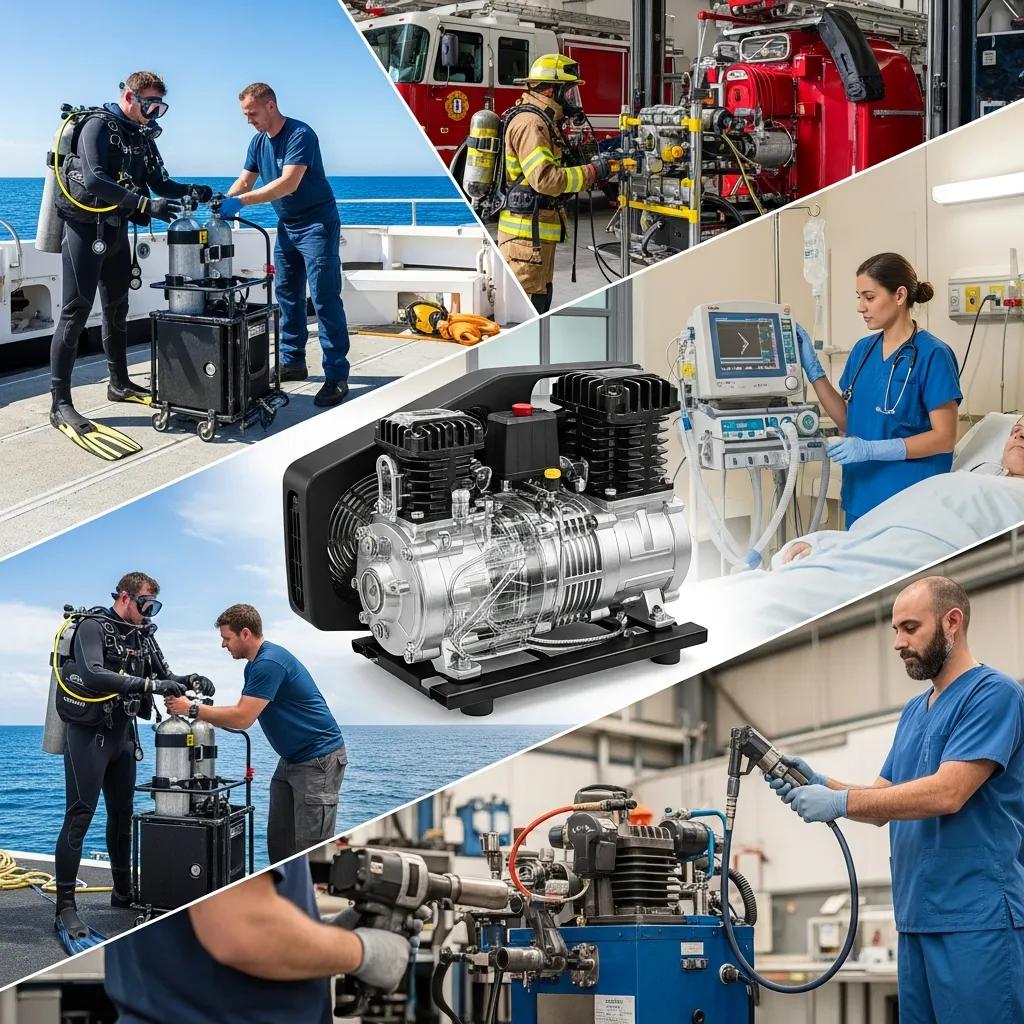
The industries that benefit most from high-pressure air compressors include:
- Diving – for filling SCUBA cylinders and providing breathing air.
- Fire Fighting – for supplying air to firefighters’ breathing apparatus.
- Industry – for various manufacturing processes requiring high-pressure air.
- Maritime/Offshore – for applications on boats and ships, such as scuba diving.
- CNG & Biogas – for compressing low-pressure gas into high-pressure forms for vehicle fueling and storage.
- Medical – for applications requiring high-purity air.
- Motor Sports – for pneumatic tools and equipment.
- Sporting Guns & Paintball – for filling air tanks.
How Are Compressors Used in Breathing Air Systems for Diving and Firefighting?
In breathing air systems for diving and firefighting, compressors compress ambient air to high pressures, filter contaminants, and store the compressed air for safe filling of SCBA (Self-Contained Breathing Apparatus) cylinders. These systems typically include a high-pressure air compressor, multi-stage purification trains, cascade storage tanks for rapid fills, and distribution panels for controlled filling. Compressors designed for continuous-duty operation are available on select models to help ensure reliable air delivery and maintain air quality standards as defined by regulations such as NFPA 1989. However, continuous operation depends on the specific compressor model and application requirements.
What Are the Roles of Compressors in Maritime, Medical, and Industrial Processes?
Compressors serve critical roles across sectors:
- Maritime: Used for scuba fills, requiring high-pressure capabilities, compact and vibration-resistant designs, and in some cases continuous operation to support multiple divers.
- Medical: Supply medical gases with emphasis on air purity and reliability, meeting specific pressure ratings and availability requirements to ensure patient safety.
- Industrial: Focus on throughput, cost efficiency, and reliability for continuous flow applications, often requiring high CFM and moderate max PSI to power machinery or tools.
Compressor selection in these fields is driven by flow, pressure, air quality, duty cycle, and operational profiles, with performance and reliability varying by configuration and model.
How Do Custom High-Pressure Compressor Solutions Meet Unique Industrial Needs?

Custom high-pressure compressor solutions are tailored to specific operational profiles, considering required pressure, flow rate, and duty cycle. This ensures the compressor meets the demands of continuous operation or specialized applications like breathing air or industrial production.
Optimizing parameters such as pressure ratio, flow rate, efficiency, and power consumption enables designs that align precisely with application needs.
By leveraging telemetry and monitoring technologies, operators can manage performance proactively, validate specifications, and adjust duty cycles as needed. The availability and extent of telemetry features may vary by manufacturer and model. Custom solutions often feature robust designs, including one-piece cast blocks for durability, and comprehensive project management and installation support to enhance reliability and reduce downtime.
Suppliers like LW Americas provide detailed engineering support, including 2D/3D installation drawings and tailored filtration systems, helping ensure compressors meet operational and maintenance expectations. This system-level approach aims to optimize compressed air systems for efficiency, safety, and compliance with industry standards.
What Is the Process for Designing Tailored Compressor Systems?
- Define Demand: Specify required pressure, simultaneous flow, and air quality standards.
- Calculate Required FAD: Determine Free Air Delivery (FAD) at working pressure, including safety margins.
- Select Duty Cycle and Architecture: Choose a duty cycle supporting peak and continuous loads based on operational profiles.
- Verify Environmental Factors: Assess installation conditions such as altitude and inlet temperature affecting performance.
- Conduct Engineering Review: For safety-critical applications, ensure compliance with standards and operational safety through thorough review.
How Does LW Americas Ensure Responsive Support and Project Completion?
LW Americas delivers responsive support and project completion through a structured workflow encompassing needs assessment, equipment selection, system design, installation oversight, commissioning, and post-installation support. Their project management coordinates site requirements with equipment delivery and commissioning, providing comprehensive handover including operating and maintenance guidance. Local support presence in North America facilitates timely response for parts and technical queries, while thorough project management aims to reduce installation complexity and downtime.
What Components and Technologies Ensure Air Purity and System Efficiency?
- Purification Modules: Remove contaminants to maintain air quality.
- Filtration Stages: Filter particulates and moisture to meet quality standards.
- Variable Speed Drives (VSDs): Enhance energy efficiency in variable-load scenarios.
- Heat Recovery Systems: Capture waste heat to reduce overall energy consumption.
- IoT Condition Monitoring: Provide real-time alerts and improve maintenance planning to reduce unplanned downtime, with capabilities varying by system and provider.
Routine maintenance such as filter changes, vibration analysis, and oil inspections is essential to sustain performance and prevent failures. Advanced technologies like AI-powered predictive maintenance can further improve reliability by proactively identifying potential issues, potentially reducing lifecycle costs and unplanned outages.
Predictive Maintenance and Monitoring of Industrial Compressors Using Machine Learning: A Proactive Approach, P Dwivedi, 2025
How Do Breathing Air Purification and Monitoring Systems Maintain Safety Standards?
Breathing air purification and monitoring systems maintain safety by controlling pressure, using certified filtration, and adhering to recognized air quality standards. These systems set limits for total hydrocarbons, carbon monoxide, moisture, and particulates, critical for diving and firefighting applications. Integration of purification modules and monitoring technologies helps ensure consistent air quality and system integrity, enhancing operational safety.
What Storage and Filling Devices Complement High-Pressure Compressors?
- Inlet buffer tank (typically ~150 liters) with safety valve, manual condensate drain valve, pressure gauge, and electrical cut-off solenoid for inlet gas.
- Storage receivers.
- Controlled distribution piping with safety valves and monitoring.
Why Is Energy Efficiency and Reliability Critical in High-Pressure Compressor Selection?
Energy efficiency and reliability directly impact operating costs, uptime, and system performance. Modern compressors emphasize energy-efficient designs and, where appropriate, continuous-duty architectures to reduce operating costs per delivered cubic foot and enable longer operation without thermal issues. Selecting compressors that prioritize these factors helps optimize total cost of ownership and operational integrity.
Industrial Compressed Air Systems: Uptime & Efficiency
Compressed air (CA) is a vital power source for tools and industrial processes, often considered a fourth utility after electricity, gas, and water. Efficient management of CA systems can save 25 to 40 percent on power costs without additional capital expenditures by reducing downtime, maintenance, and improving productivity and quality.
Applications Guide for Compressed Air Systems, 2001
How Do Continuous Duty Compressors Reduce Lifecycle Costs?
Continuous-duty compressors designed for extended operation can reduce lifecycle costs by minimizing downtime and maintenance needs. Features like variable-speed drives and optimized designs may improve energy efficiency and lower operating costs per delivered cubic foot. IoT-enabled predictive maintenance tools can support proactive servicing, reducing unexpected failures and associated expenses. However, continuous-duty operation is available on select models and should be matched to application requirements and compressor capabilities.
What Safety Standards and Certifications Should Industrial Compressors Meet?
Industrial compressors, especially those used in breathing air and safety-critical applications, should comply with relevant standards such as EN 12021 for breathing air quality, NFPA 1989 for SCBA systems, and ISO 8573-1 for compressed air purity where applicable. Compliance depends on the entire system configuration—including filtration, monitoring, and storage—not the compressor alone. LW Americas supports customers in meeting these standards through system-level engineering and project management.
How to Choose the Right High-Pressure Air Compressor for Your Industrial Application?
- Define Requirements: Specify total hydrocarbons, CO, moisture, and particulate limits; expected fills per hour; simultaneous fill points; recovery times; and air quality test intervals.
- Pressure and Flow Needs: Identify target cylinder pressures (typically 3000–4500 PSI) and ensure compressor Free Air Delivery (FAD) meets operational demands.
- Duty Cycle: Select continuous-duty designs available on certain models for busy operations to reduce queue times and maintain safety margins; otherwise, consider intermittent-duty models as appropriate.
- Filtration and Drying: Tailor filtration and drying stages to meet applicable breathing air guidelines and application-specific purity requirements.
- Monitoring and Controls: Ensure controls support quality parameter monitoring and routine sampling.
- Redundancy and Safety: Consider redundancy strategies such as standby compressors or automatic switchover for critical applications.
- Custom Engineering: Prepare for custom engineering needs including installation drawings and integrated monitoring systems.
- Consultation with Suppliers: Engage equipment providers like LW Americas to share operational profiles and request tailored solutions combining appropriate pressure, flow, duty cycle, and monitoring capabilities.
What Factors Influence Compressor Type and Configuration Selection?
- Demand Specifications: Required pressure, simultaneous flow, and air quality standards.
- Flow Rate and Duty Cycle: Peak and average CFM needs, matching duty cycle ratings to operational profiles.
- Environmental Conditions: Altitude, inlet temperature, and gas type affecting FAD and cooling requirements.
- Application Context: Differences between industrial and medical applications, including gas composition control and redundancy needs.
- Safety Considerations: Comprehensive engineering review for safety-critical applications.
- Operational Profiles: Frequency of peaks versus steady continuous demand.
- Technical Factors: Inlet filtration, cooler capacity, motor drive sizing, and mechanical design.
- Redundancy Strategies: Standby compressors or automatic switchover for critical systems.
How Can Industry-Specific Requirements Shape Compressor Choices?
Industry-specific requirements influence compressor selection by dictating gas composition control, purity and sterility standards, redundancy needs, and environmental considerations. Medical applications demand stringent filtration and monitoring for consistent air purity, while industrial settings balance peak and average demand, integrate with plant controls, and ensure safety interlocks. These factors determine sizing, duty cycle, and control architecture, often requiring custom engineering to meet operational and safety standards.