
Dive Compressor Rental vs Purchase: Operational Considerations for High-Pressure Breathing Air Systems
High-pressure dive compressors are central to safe, compliant breathing air supply, and choosing between renting and purchasing has direct safety, operational and financial consequences for dive operations.
This article explains the compressor purchase decision and dive compressor rental trade-offs so operators can compare total cost of ownership, uptime requirements, air-quality obligations (often guided by standards like EN12021), and logistical constraints that shape optimal choices. The decision is primarily framed by usage frequency, service access, maintenance liability, and capital availability.
Readers will learn what high-pressure compressors do, how continuous-duty designs affect throughput and maintenance, the operational components that drive the decision between rental and ownership, and practical decision criteria for occasional, seasonal, and heavy commercial use.
Throughout the guide we use semantic comparisons—types, parts, and related entities like purification modules and storage banks—to clarify trade-offs and to help you calculate ROI.
The article concludes with a pragmatic decision framework and options for evaluation or an on-site systems assessment by LW Americas as a specialized supplier of continuous-duty compressors, NitroxMaker™ and YachtPro™ systems to support implementation and long-term service planning.
What Are High-Pressure Dive Compressors and Their Role in Breathing Air Supply?
High-pressure dive compressors are gas compression equipment that pressurize and deliver breathing air into storage cylinders or filling manifolds at the pressures required for scuba and commercial diving.
They function by increasing gas pressure through staged compression, removing contaminants with purification modules, and enabling safe, standards-compliant fills that often meet breathing air quality standards like EN12021.
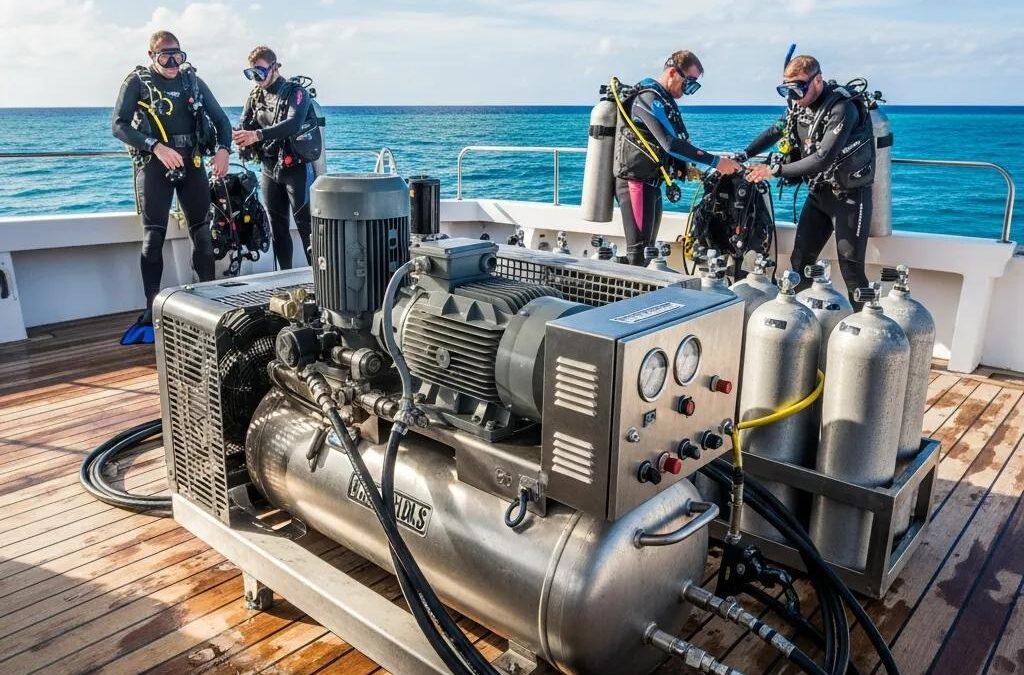
These compressors appear as portable dive air supply units for field fills or as stationary high-pressure compressors integrated into dive shops, maritime vessels and emergency-response systems.
Understanding the difference between portable and stationary systems clarifies rental versus purchase decisions and sets the stage for assessing throughput and quality controls.
Operators commonly select among several compressor families based on use case and site constraints:
- Portable dive air supply units for remote fills and mobile operations.
- Mobile scuba tank fill compressors with skids and quick-connect manifolds.
- Stationary high-pressure compressors for dive shops or onboard vessels.
These hyponyms map directly to operational needs: portability prioritizes transportability and quick hook-up, while stationary units optimize continuous-duty operation and integration with storage cylinders. The next subsection explains how continuous-duty compressors specifically change operational outcomes for high-frequency fills.
How Do Continuous-Duty Compressors Enhance Dive Operations?
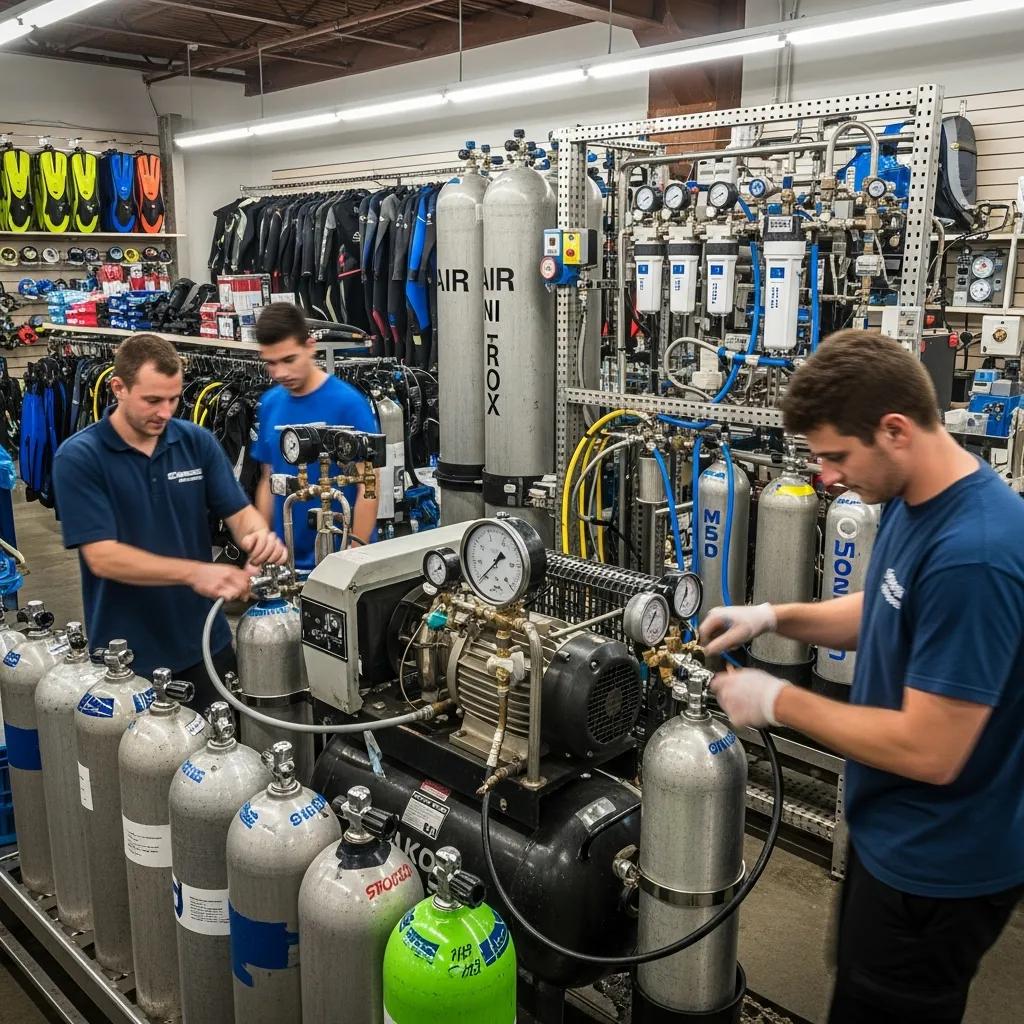
Continuous-duty compressors are engineered to run for extended periods without the heat and wear limitations common to intermittent designs, and that enables higher throughput with lower downtime.
Mechanically, continuous-duty designs use lower RPMs and robust components—such as one-piece cast compressor blocks—which reduce vibration, reduce wear on seals, and extend service intervals compared with higher-RPM intermittent units.
The operational result is predictable delivery rates during peak fill days, more consistent cylinder turnaround, and simplified scheduling for dive shops and maritime operations where uptime is mission-critical.
In practice, continuous-duty compressors pair well with storage banks and filling manifolds to smooth peak demand, which also reduces labor pressure on staff and optimizes operational efficiency compared with cycling smaller portable units.
Because continuous-duty capability changes maintenance cadence, the following section addresses why breathing air quality and purification are equally important for safe compressor operation.
Why Is Breathing Air Quality Critical for Dive Compressor Use?
Breathing air quality matters because contaminants—oil, carbon monoxide (CO), moisture, and particulates—create acute and chronic hazards when compressed and delivered as breathing gas; industry standards, such as EN12021, often set limits for oxygen, CO, CO₂ and contaminants to assure safety.
Effective purification includes pre-filtration, coalescing filters, adsorption beds and regular testing; these meronyms—air purification module, storage cylinders, filling manifold—form the functional chain that keeps breathing air within specification.
Operators must schedule filter changes, perform CO and moisture testing at prescribed intervals, and maintain documentation to demonstrate compliance, especially in commercial or regulated applications.
Good practices include using oil-free compression where feasible, monitoring compressor operating parameters, and pairing compressors with NitroxMaker™ or similar systems when gas blending is required for enriched-air applications.
What Are the Operational Differences Between Renting and Purchasing Dive Compressors?
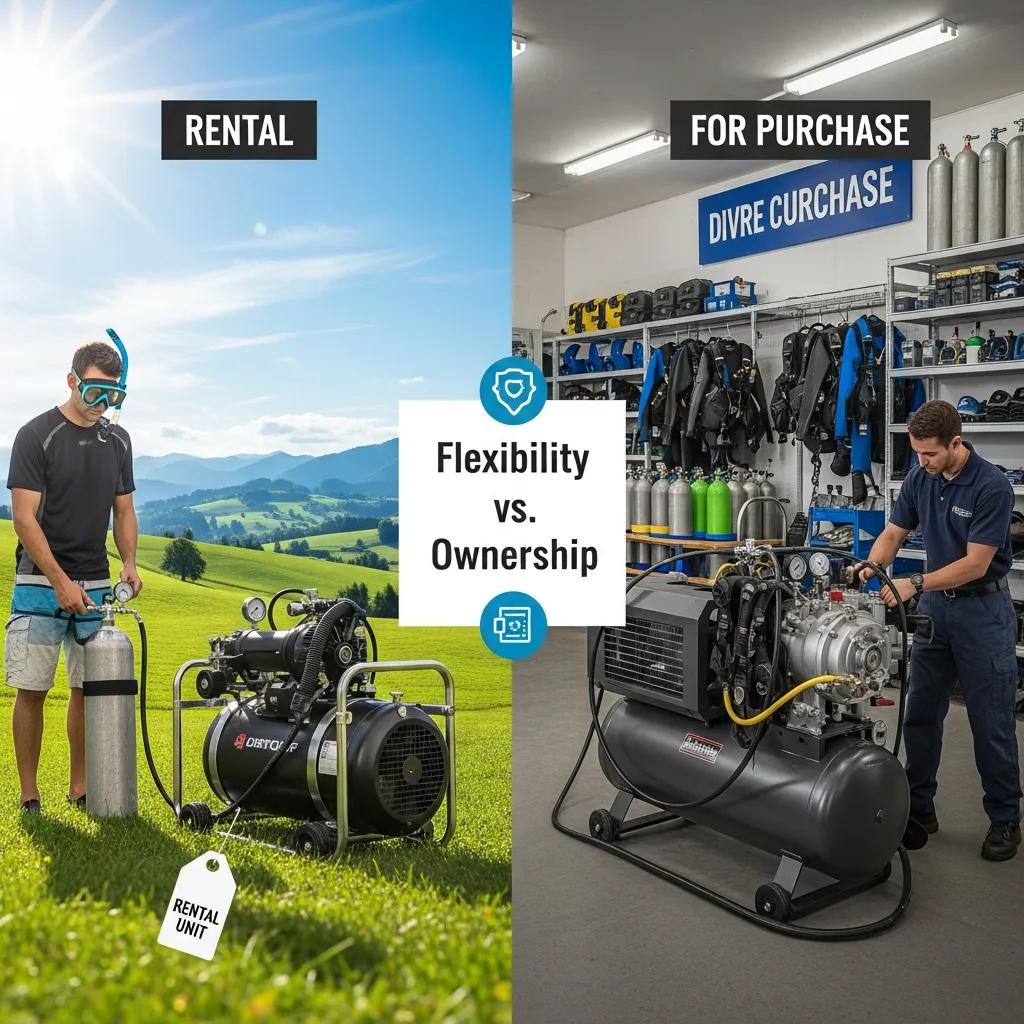
A clear comparison separates upfront capital, recurring operating expenses, and long-term operational outcomes—renting typically requires less initial capital but may involve different operational expenses, while purchasing concentrates capital outlay and offers distinct long-term operational characteristics.
When buying, expect a significant initial investment and ongoing costs for energy, filter media, scheduled maintenance, and parts; when renting, expect periodic rates plus transport and potential surcharges for specific needs.
Depreciation and potential long-term value shape total cost of ownership, and lease financing can spread capital but adds financing costs that affect the overall financial picture.
To support decision-making, the following table contrasts Rent / Buy / Lease across core financial and operational attributes.
Intro: The table below compares rental, purchase, and lease options across typical financial and operational attributes so decision-makers can weigh trade-offs objectively, focusing on capital availability, maintenance liability, service access, and usage frequency.
How Do Upfront and Long-Term Operational Characteristics Compare for Rental vs Purchase?
Evaluating the long-term financial implications requires inputs such as initial investment, expected annual hours or fills, operational expenses, and the value of consistent service access. A comprehensive model compares the total operational expenditure of ownership against the periodic costs of rental, considering factors like utilization and service requirements.
For example, an operation with high annual fill volumes and mission-critical uptime may find ownership more advantageous over time due to consistent service access and predictable operational characteristics, which can outweigh the initial capital investment.
Key KPIs to track include operational efficiency per fill, cost per operating hour, downtime cost per hour, and annual maintenance spend, which together provide the datapoints for an ROI calculation.
What Hidden and Operational Expenses Should Be Considered?
Beyond initial investment and periodic rates, hidden costs frequently alter the economics: transport and logistics for mobile fills, insurance differentials between rented and owned equipment, training and certification for operators, and regulatory testing or documentation.
Downtime after equipment failure has opportunity cost measured in missed fills and customer satisfaction impact; rental units require careful verification of maintenance history to mitigate this risk.
Contractual protections—service-level agreements, spare-parts guarantees, and clear liability clauses—reduce hidden exposure but may add to rental cost.
A focused checklist helps capture these line items when modeling total cost:
- Transport and logistics expenses for moving compressors to and from sites.
- Insurance, liability coverage differences, and rental deposit risks.
- Training and certification costs for operators and maintenance staff.
- Unexpected downtime costs and spare-parts availability.
Accounting for these items leads to a more accurate lifecycle model and prepares operators to negotiate rental terms or service contracts, which is the subject of the next section on operational pros and cons.
What Are the Operational Advantages and Disadvantages of Renting Dive Compressors?
Renting offers operational flexibility, fast access to portable diving air supply when needed, and avoids capital commitments, making it a good fit for short-term projects and trialing equipment types.
The downsides include potential availability constraints during busy seasons, and the need for operators to conduct due diligence to verify maintenance histories and confirm air-quality controls on each rental unit before accepting it into service. The responsibility for ensuring compliance with breathing air standards, such as EN12021, ultimately rests with the operator, regardless of ownership.
Operators evaluating rental providers should vet maintenance records, purification modules installed, and confirm whether the unit is capable of meeting relevant breathing air standards, such as EN12021. Negotiating service-level guarantees can help reduce availability and quality risks.
When Is Renting a Portable Dive Air Compressor Most Beneficial?
Renting is most beneficial for infrequent fills, temporary events, seasonal peaks, or pilot testing where capital purchase is not justified by projected utilization.
For example, support for a multi-day training event, a one-off commercial inspection, or emergency response deployments commonly favors rental because it provides immediate capacity with minimal logistics.
A rental-selection checklist should confirm compressor flow rate, pressure rating, installed purification modules, noise levels, and available service support to ensure compatibility with mission requirements.
What Are the Limitations and Risks of Rental Equipment?
Common rental limitations include the need to verify maintenance histories to assess failure risk, possible incompatibility of fittings and accessories, and the operator’s responsibility to ensure air quality if purification modules are not properly maintained.
Liability and insurance coverage must be clarified in rental agreements to determine who bears responsibility for damage or contamination.
Best practices include pre-delivery inspection, documentation of CO and moisture readings upon receipt, and a written SLA that specifies response times for breakdowns.
Mitigating these risks often requires a short service-level agreement and an inspection protocol, which operators can use while comparing the long-term benefits of ownership covered in the next section.
What Are the Benefits and Challenges of Purchasing High-Pressure Dive Compressors?
Purchasing delivers predictable availability, the ability to customize systems for specific missions, and potential long-term operational efficiencies when utilization is high and maintenance is managed effectively.
Ownership enables integration with purification, storage, and filling manifolds and supports blending systems like NitroxMaker™ where enriched-air capability is required.
Challenges include upfront capital, space and storage requirements, the need for trained maintenance personnel, and planning for scheduled service intervals and spare-part inventory to avoid extended downtime.
To clarify ownership decisions across compressor classes, the table below compares typical compressor model types and attributes relevant to ownership.
How Does Ownership Improve Reliability and Customization?
Ownership improves reliability by enabling scheduled preventive maintenance, consistent use of OEM parts, and controlled operating environments that limit contamination risk; this yields fewer unexpected outages and enhanced reliability.
Customization options include tailored purification trains, storage banks sized for peak demand, and integration with YachtPro™ packages for maritime installations.
These custom integrations reduce operator labor during fills and can improve throughput and safety, which collectively contribute to enhanced operational efficiency over the equipment lifecycle.
What Maintenance and Storage Responsibilities Come with Ownership?
Owners are responsible for routine tasks—filter replacement, oil changes for non oil-free designs, belt inspections, pressure-testing storage cylinders, and scheduled CO/moisture testing—to keep air quality within applicable standards, such as EN12021, and maintain warranty conditions.
Storage considerations include secure mounting, proper ventilation, and environmental controls to prevent corrosion or condensation that shorten component life.
Owners must budget for spare filters, common wear parts, and occasional overhauls; outsourcing maintenance to qualified service providers is an alternative that trades labor time for predictable service costs.
A strategic maintenance schedule and documented storage plan reduce long-term costs and guide the purchase-versus-rent decision that follows, where supplier support becomes a differentiator.
How Does LW Americas Provide Superior Dive Compressor Solutions?
LW Americas is a specialized provider of high-pressure compressor and gas systems in North and South America and acts as the exclusive regional distributor for L&W Compressors of Germany, supplying continuous-duty scuba tank fill compressors, NitroxMaker™ systems, YachtPro™ systems, purification, storage, filling solutions, and custom dive systems.
The company’s value proposition centers on robust engineering—such as one-piece cast blocks and lower RPM continuous-duty designs—comprehensive system configurations that integrate purification and storage, and responsive North American parts and service support.
What Unique Features Do LW Americas’ Continuous-Duty Compressors Offer?
LW Americas’ continuous-duty compressors emphasize design features that reduce wear and downtime: robust one-piece cast compressor blocks that lower vibration, lower RPM operation that increases seal life, and compatibility with modular purification and storage banks for compliance with relevant breathing air standards, such as EN12021.
The operational benefits include sustained throughput during peak demand, quieter operation that eases staff exposure to noise, and reduced service frequency, which can contribute to reduced lifecycle maintenance.
These feature-to-benefit relationships make continuous-duty compressors particularly well-suited to busy dive shops, commercial teams, and marine installations where predictable performance and integration with NitroxMaker™ or YachtPro™ systems matter.
How Do Custom Solutions and Support Enhance Dive Compressor Investment?
Custom engineering allows LW Americas to tailor compressor skids, portable packages, and yacht installations to site constraints, integrating purification modules, storage cylinders and filling manifolds to meet specific throughput and quality needs.
Responsive parts availability and authorized service pathways in North America reduce downtime and simplify lifecycle management, while initial site surveys and operator training help ensure correct installation and safe operation.
Together, system customization and local support lower the operational risk of ownership and improve ROI by keeping equipment online and compliant with breathing air standards.
How Can Businesses Decide Between Renting and Purchasing Dive Compressors?
Deciding between renting and purchasing requires a structured checklist that weighs usage frequency, mission-critical uptime, budget constraints, storage, regulatory obligations, and vendor support for parts and service.
A practical approach uses a short scoring rubric: estimate annual fills or hours, score the criticality of uninterrupted availability, assign a budgetary tolerance for capital expenditure, and rate access to space and trained staff for maintenance.
This produces an initial recommendation—rent for low scores and purchase for high utilization and high-criticality operations—and helps prioritize next steps like trial rentals, pilot purchases, or requesting a site evaluation by a supplier.
The decision framework below provides a compact, action-oriented checklist to guide immediate choices.
- Estimate Annual Usage: Quantify expected fills or operating hours for the next 3–5 years.
- Assess Uptime Criticality: Rate how damaging downtime is to operations and reputation.
- Evaluate Capital vs Operating Budget: Determine available capital and appetite for financing.
- Check Space and Maintenance Capacity: Confirm storage, ventilation, and trained staff availability.
This checklist prepares operators to run an ROI calculation, which is detailed in the final subsection along with a recommendation to involve a systems partner for evaluation when appropriate.
Intro: The table below aligns common use cases with recommended approaches to clarify which option tends to be most appropriate, considering usage frequency, service access, maintenance liability, and capital availability.
Summary: Mapping use cases to approach helps prioritize procurement and ensures operators align investment with expected utilization and risk tolerance.
What Factors Should Influence the Rental vs Purchase Decision?
Primary factors include operational cadence (annual fills), criticality of uptime, available budget or financing options, storage and maintenance capacity, regulatory obligations for testing and documentation, and supplier support for parts and service.
Weight each factor according to organizational priorities—safety and compliance should carry high weight for commercial operators—then compute a simple score that points toward renting, leasing, or purchasing.
This rubric reduces ambiguity and focuses stakeholder discussions on measurable inputs like operational efficiency per fill, expected downtime impact, and vendor response times.
How to Calculate ROI and Long-Term Value for Dive Compressor Investments?
Calculate ROI by estimating total lifecycle costs for purchase (capital + cumulative operating and maintenance costs over a multi-year horizon) and comparing them to cumulative rental costs for the same period; analyze total costs relative to expected fills to understand the long-term value and identify when ownership becomes more operationally efficient than renting.
Key inputs include initial investment, potential long-term value, annual maintenance, energy cost, periodic rental rates, and downtime cost per hour.
Track KPIs post-purchase—operational efficiency per fill, annual service spend, and unplanned downtime hours—to validate the decision and refine future procurement choices.
Practical next steps include running a 3–5 year modeled comparison and contacting a systems partner for a site survey or tailored quote; for operators needing integrated continuous-duty systems and North American support, LW Americas can provide system proposals, customization, and service planning to support accurate ROI modeling.